

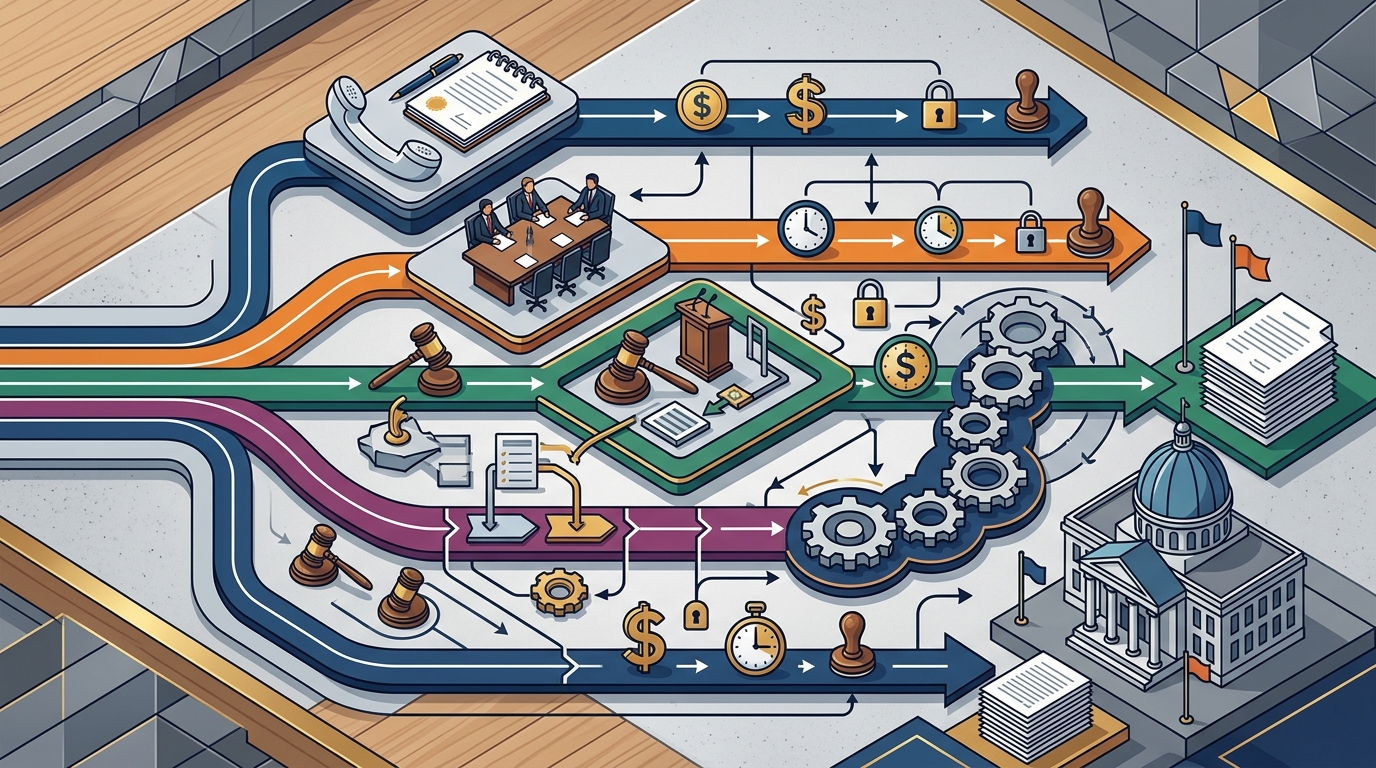
When co-owners clash, contracts collapse, or fiduciary duties are breached, New Jersey businesses face a critical decision: how to resolve the conflict. The answer is rarely one-size-fits-all. This comparison breaks down five distinct resolution methods—from a quiet phone call between attorneys to a full trial in the Chancery Division—so you can weigh cost, speed, confidentiality, and enforceability before committing to a strategy.
1. Direct Negotiation: The First Line of Defense
Before any formal proceeding, most experienced business attorneys explore negotiation. This involves structured, attorney-guided discussions between the disputing parties aimed at crafting a voluntary resolution—typically a buyout agreement, revised operating terms, or a separation plan.
When Negotiation Works Best
- Ongoing business relationships you want to preserve, such as a family-held manufacturing company where two siblings disagree on expansion strategy.
- Low-to-moderate financial stakes where the cost of formal proceedings would dwarf the dispute itself.
- Clear contractual frameworks—if your shareholder agreement or LLC operating agreement already includes buyout formulas, negotiation can proceed by reference to those terms.
Limitations
Negotiation lacks a neutral decision-maker and produces no enforceable order unless memorialized in a signed agreement. If one party is acting in bad faith—embezzling funds, freezing the other out of operations—negotiation alone usually cannot protect you.
2. Mediation: Guided Settlement with a Neutral Facilitator
Mediation introduces a trained neutral who facilitates discussion but does not impose a decision. In New Jersey, attorneys in the ADR space focus on helping disputants reach resolution by concentrating on underlying interests rather than rigid positions.
How It Works in New Jersey
New Jersey courts actively promote mediation through their Complementary Dispute Resolution (CDR) programs. Under New Jersey Court Rule 1:40, attorneys are required to inform clients about CDR options, and courts can mandate CDR participation at various stages of litigation. Mediation and arbitration are the most commonly used CDR programs in the state.
Practical Advantages
- Confidentiality: ADR offers more confidentiality during sensitive business disputes by avoiding the public scrutiny inherent in courtroom proceedings.
- Cost control: By avoiding extensive pretrial proceedings, mediation keeps costs significantly lower than trial.
- Speed: A typical corporate mediation in New Jersey can conclude in one to three sessions, compared to 12–24 months for litigation.
- Creative outcomes: Mediators can help parties devise solutions—restructured equity splits, phased buyouts, operational truces—that a court cannot order.
When to Think Twice
If the other side refuses to engage honestly, mediation stalls. It also cannot produce emergency relief like a temporary restraining order when assets are being dissipated.
3. Arbitration: Private Adjudication with a Binding Outcome
Arbitration sits between mediation and litigation. A neutral arbitrator (or panel) hears evidence and issues a binding, generally unappealable decision. Many shareholder agreements and LLC operating agreements in New Jersey include mandatory arbitration clauses, making this the default pathway for certain disputes.
Key Features
- Binding finality: In arbitration, a neutral third-party hears evidence and issues a binding decision, which is swifter and less expensive than courtroom litigation.
- Forum selection: Many New Jersey business disputes are arbitrated through the American Arbitration Association (AAA), which offers specialized commercial and construction panels.
- Streamlined discovery: Arbitration rules typically limit depositions and document requests, reducing time and cost.
Drawbacks to Consider
- No meaningful appeal: You sacrifice the appellate safety net. Courts will vacate an award only for fraud, corruption, or an arbitrator exceeding their authority.
- Costs can escalate: Arbitrator fees—particularly for multi-arbitrator panels—can rival litigation expenses in high-value disputes.
- Limited equitable relief: While some arbitrators grant injunctive relief, many corporate disputes require the full equitable toolkit available in Chancery.
4. Chancery Division Litigation: New Jersey's Equity Court
For corporate disputes requiring court-ordered remedies beyond a monetary judgment, the Chancery Division of New Jersey's Superior Court is the primary forum. This is the state's court of equity—and the venue where shareholder oppression claims, business divorces, and corporate governance fights are typically decided.
What Makes Chancery Unique
The Chancery Division can grant equitable relief that goes far beyond awarding money damages. In practice, the chancery judge has the power to order parties to perform specific acts—or to refrain from doing something—making it ideally suited to complex business disputes. Cases are heard by a judge without a jury, and the most experienced judges are often assigned to the Chancery Division.
Types of Relief Available
- Temporary restraining orders and preliminary injunctions to prevent asset dissipation or operational sabotage
- Forced buyouts of oppressed minority shareholders or LLC members
- Corporate dissolution when deadlock or oppression makes continued operation impracticable
- Appointment of a fiscal agent or custodian to manage business operations during litigation
- Specific performance of contractual obligations, such as enforcing a partnership agreement's mandatory capital contributions
A Practical Example
Consider two equal members of an LLC operating a chain of medical practices in Bergen County. One member begins diverting patients to a competing practice. Direct negotiation fails. Mediation is declined. In Chancery, the aggrieved member files an order to show cause, obtains a temporary restraining order freezing the diversion of business, and the court ultimately orders a buyout based on a forensic valuation—a remedy only the Chancery Division can fashion in real time.
5. Complex Business Litigation Program (CBLP): New Jersey's Specialized Track
Not every business lawsuit warrants the CBLP, but for high-stakes commercial disputes, this statewide program offers significant procedural advantages.
Eligibility and Structure
A case is automatically assigned to the CBLP if the amount in controversy is at least $200,000 and the parties designate the case as complex commercial or complex construction. The program is designed to resolve complex business, commercial, and construction cases in an expedited manner, using dedicated judges in each of New Jersey's 15 vicinages.
What the CBLP Covers—and What It Does Not
The CBLP handles disputes involving the UCC (non-consumer), asset purchases, mergers and acquisitions, franchises, business torts, officer and director liability, and other complex commercial matters. However, it does not encompass general equity matters within the Chancery Division's traditional jurisdiction—such as corporate governance, dissolution, or shareholder oppression claims—which remain with the General Equity judge.
Why It Matters
The CBLP assigns a single judge to handle a case from start to finish, applies initial disclosure requirements similar to Federal Rule 26(a), and imposes structured case management timelines. For a breach-of-contract suit between two technology companies over a failed $2 million software licensing deal, the CBLP track ensures tighter deadlines and a judge experienced in commercial matters.
Side-by-Side Comparison Table
| Factor | Negotiation | Mediation | Arbitration | Chancery Litigation | CBLP |
|---|---|---|---|---|---|
| Cost | Low | Low–Moderate | Moderate–High | High | High |
| Timeline | Days–Weeks | Weeks–Months | Months | 12–24+ Months | 12–18 Months |
| Confidentiality | High | High | High | Low (public record) | Low (public record) |
| Binding Result | Only if agreement signed | Only if agreement signed | Yes | Yes (appealable) | Yes (appealable) |
| Equitable Relief | No | No (voluntary only) | Limited | Full | Limited (commercial focus) |
| Appeal Rights | N/A | N/A | Very limited | Full (Appellate Division) | Full (Appellate Division) |
| Best For | Preserving relationships | Good-faith disputes | Contract-mandated ADR | Shareholder oppression, business divorce | Large commercial/contract disputes |
Real-World Scenario Analysis
Scenario A: Deadlocked 50/50 LLC
Two members of a Hoboken-based restaurant group each own 50%. They disagree on whether to expand or sell. Their operating agreement has no deadlock provision and no ADR clause.
Best path: Start with mediation. If mediation fails, file in the Chancery Division seeking judicial dissolution or a court-ordered buyout. The Chancery judge can order dissolution of an LLC, force a buyout, or appoint a custodian—none of which are available through mediation or arbitration alone.
Scenario B: Breach of a Distribution Agreement
A Parsippany distributor breaches a $500,000 exclusive distribution contract with a Newark manufacturer. The contract includes an AAA arbitration clause.
Best path: Arbitration, as required by the contract. The manufacturer should file with the AAA, request expedited procedures, and seek damages plus injunctive relief to prevent the distributor from supplying competitors during the proceeding.
Scenario C: Minority Shareholder Freeze-Out
A 20% shareholder of a closely held construction firm in Trenton discovers the majority shareholders have tripled their own salaries, stopped declaring dividends, and excluded her from board meetings.
Best path: File a shareholder oppression action in the Chancery Division immediately. Seek a temporary restraining order to prevent further self-dealing, and request a court-ordered buyout at fair value. This scenario demands the full equitable powers only Chancery can provide.
How to Choose the Right Path
The optimal resolution method depends on several interrelated factors:
- Review your governing documents first. If your shareholder agreement, LLC operating agreement, or commercial contract includes an ADR clause, that provision may control. Many agreements mandate arbitration or mediation before litigation is permitted.
- Assess urgency. If assets are being dissipated or you are being frozen out of operations, you likely need emergency Chancery relief—not a mediation session.
- Evaluate the relationship. If you want to continue doing business together, mediation or negotiation preserves the relationship far better than adversarial litigation.
- Consider the dollar amount. For disputes exceeding $200,000 in commercial contexts, the CBLP offers a more efficient litigation track with dedicated judicial resources.
- Weigh confidentiality needs. Court filings are public. If the dispute involves trade secrets, financial irregularities, or reputational risk, ADR keeps matters private.
Key New Jersey Rules and Statutes to Know
- N.J. Court Rule 1:40 — Governs CDR programs; requires attorneys to advise clients of all available CDR options.
- N.J.S.A. 42:2C (Revised Uniform Limited Liability Company Act) — Governs LLC disputes, member rights, and judicial dissolution when no operating agreement controls.
- N.J.S.A. 14A:12 (Business Corporation Act – Dissolution) — Provides statutory grounds for corporate dissolution, including deadlock and oppression.
- Superior Court Directive #01-19 — Establishes the CBLP's case management guidelines, model forms, and model orders statewide.
Key Takeaways
- New Jersey offers five main paths for corporate dispute resolution: negotiation, mediation, arbitration, Chancery Division litigation, and the Complex Business Litigation Program.
- Almost 98% of civil cases in New Jersey are resolved without a trial—ADR plays a central role.
- The Chancery Division is uniquely equipped for business divorces, shareholder oppression, and disputes requiring injunctions, buyouts, or dissolutions.
- The CBLP is reserved for commercial disputes of at least $200,000 and does not cover corporate governance or internal affairs matters, which belong in Chancery's General Equity Part.
- Your governing documents—shareholder agreements, operating agreements, commercial contracts—often dictate which resolution method applies. Review them before choosing a strategy.
- Confidentiality, speed, cost, and the availability of equitable remedies should all factor into your decision.
Frequently Asked Questions
What court handles corporate disputes in New Jersey?
Most corporate disputes are heard in the Chancery Division of the New Jersey Superior Court. The Chancery Division has jurisdiction over matters where a party seeks principally equitable relief, including partnership breakups, corporate dissolutions, and injunctions to protect trade secrets. For commercial disputes valued at $200,000 or more, the Complex Business Litigation Program provides a specialized litigation track within the Law Division.
Is mediation mandatory for corporate disputes in New Jersey?
Not initially, but courts can mandate CDR participation under Court Rule 1:40. Many corporate governing documents also include ADR clauses requiring mediation or arbitration before any party can file suit. Attorneys in New Jersey are required to know about CDR programs and inform their clients of them.
What is a business divorce in New Jersey?
A business divorce is the legal dissolution of a co-ownership relationship—whether among shareholders, LLC members, or partners. Common triggers include oppression of minority owners, deadlock on key decisions, breach of fiduciary duty, and embezzlement. These cases are typically heard in Chancery, where the judge can order forced buyouts, dissolution, or appointment of a custodian.
How much does corporate dispute resolution cost in New Jersey?
Costs range widely. Negotiation involves only attorney time. Mediation adds mediator fees (often $300–$750 per hour for experienced neutrals). Arbitration through the AAA involves filing fees, arbitrator compensation, and legal costs. Full Chancery litigation—especially cases involving forensic accounting, business valuations, and expert witnesses—can cost tens of thousands to millions of dollars depending on complexity.
Can I appeal an arbitration decision in New Jersey?
Binding arbitration awards are generally final. New Jersey courts will vacate an award only under extremely narrow circumstances—such as fraud, corruption, or the arbitrator exceeding their authority. If preserving the right to appeal is important, courtroom litigation in the Chancery Division or CBLP may be more appropriate than arbitration.
Next Steps
If your New Jersey business is facing an internal dispute or a conflict with another company, the first step is a candid assessment of the dispute's facts, the governing documents, and your strategic priorities. An experienced New Jersey corporate litigation attorney can help you evaluate whether negotiation, mediation, arbitration, or courtroom proceedings offer the strongest path to resolution. Contact a qualified lawyer to review your situation before deadlines pass or the other side gains a tactical advantage.