

Whether you are buying a company, negotiating a commercial lease, or forming a joint venture, the attorney you choose can make or break the deal. This step-by-step guide shows New Jersey business owners exactly how to identify, evaluate, and hire a transactional lawyer who protects their interests from letter of intent through closing.
Why You Need a Dedicated Business Transaction Attorney
Business transactions in New Jersey span a wide spectrum — asset purchases, stock sales, franchise acquisitions, mergers, partnerships, and seller-financed deals. Each carries unique legal, tax, and operational risks. A general practitioner may lack the specialized knowledge these deals require.
A qualified transactional attorney helps you avoid unnecessary expenses, taxation issues, and legal complications while minimizing liabilities and risks in contracts and transactions. Sound legal guidance is essential because even a minor oversight in a purchase agreement can create problems long after the deal closes.
Business transactions also require understanding of intellectual property transfer, employment agreements, and regulatory compliance — all areas where a dedicated attorney adds measurable value.
Step 1 — Define the Scope of Your Transaction
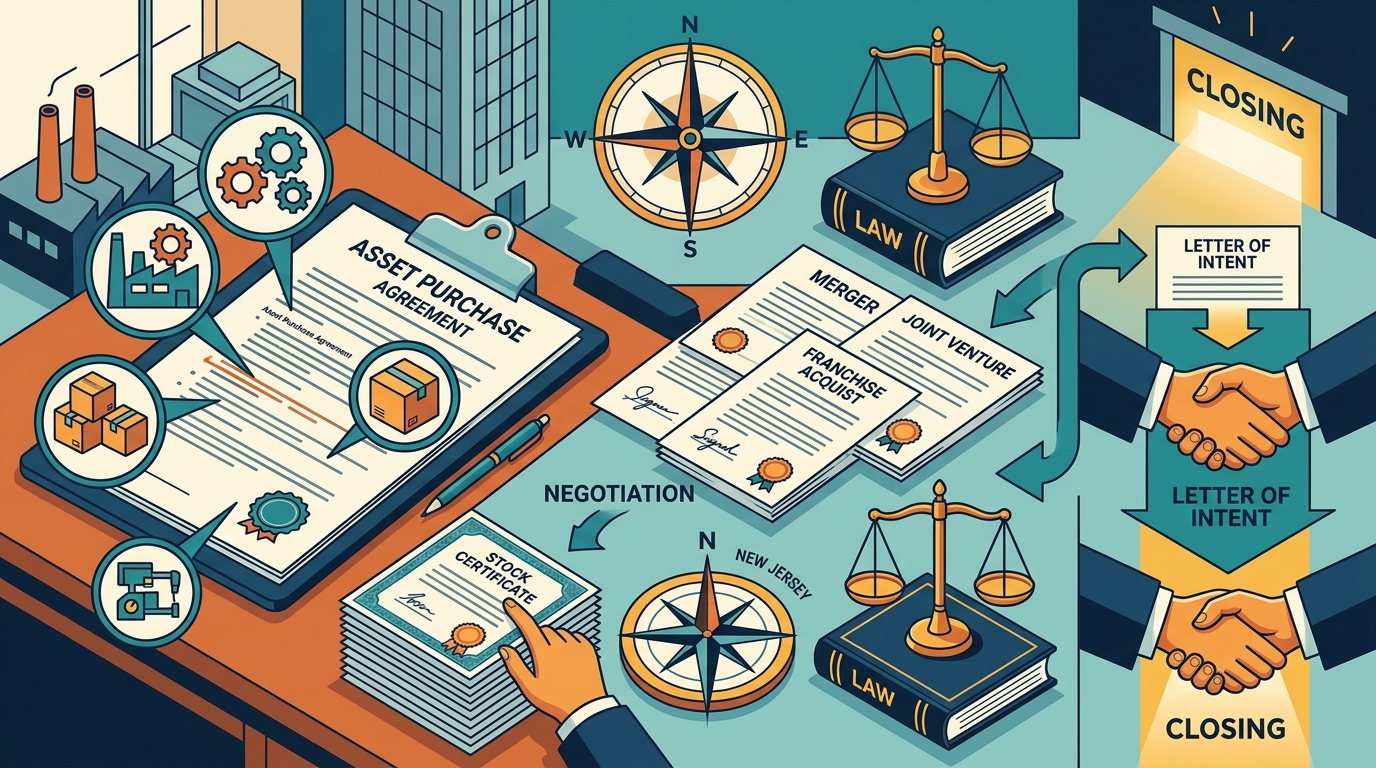
Before you start searching for a lawyer, clarify the type of deal you are pursuing. Business transactions come in many different forms, such as the purchase of an entire business, the purchase of a business's assets, a sale of stock, franchise purchases, the merger of two companies, joint ventures, partnerships, or a sale with seller financing and the seller's continued involvement.
Each structure demands different legal documents, regulatory filings, and tax strategies. Knowing what you need lets you narrow your search to attorneys with directly relevant experience rather than casting a wide net.
Questions to answer before your search
- Am I buying or selling — and is it assets, equity, or a merger?
- Does the deal involve real estate, intellectual property, or both?
- Will there be seller financing or an earnout?
- What is the approximate deal value?
- Are there employees who will transfer?
Step 2 — Verify New Jersey Licensing and Good Standing
Every attorney you consider must hold an active license issued by the Supreme Court of New Jersey. To be admitted to the bar in New Jersey, an applicant must graduate from an ABA-accredited law school, pass the New Jersey Bar Exam, and receive a Certification of Character. The New Jersey Board of Bar Examiners administers the exam, while the New Jersey Office of Attorney Ethics handles attorney misconduct complaints.
You can verify an attorney's status through the New Jersey Courts website. Attorneys licensed in New Jersey must complete annual registration and pay all required fees each year to maintain eligibility. An attorney who is ineligible due to nonpayment of fees cannot represent you in any New Jersey matter.
Additionally, active lawyers must complete 24 credit hours of continuing legal education every two years, including at least 5 credits in ethics and professionalism. This ongoing education requirement helps ensure your attorney stays current with evolving business law.
Step 3 — Prioritize Relevant Transactional Experience
Not every business lawyer handles transactions. Some focus exclusively on litigation. Look for firms where transactional work — contract negotiation, deal structuring, and closing — is a core practice area rather than a sideline.
Strong indicators of relevant experience include:
- Track record with buyers and sellers: The best firms have represented both sides, giving them insight into how the other party thinks.
- Industry-specific knowledge: A lawyer who has closed deals in your industry understands its regulatory environment.
- Deal-size alignment: A solo practitioner who handles small-business sales may not be the right fit for a complex M&A transaction, and vice versa.
- Peer recognition: Awards such as inclusion in Best Lawyers in America® signal that an attorney has been vetted by peers in the field of corporate law.
Step 4 — Evaluate the Firm's Collaborative Approach
Complex business transactions rarely involve only a single discipline of law. The best transactional firms work closely with other professionals, including accountants, brokers, architects, engineers, title companies, surveyors, environmental consultants, and bankers to ensure that any given matter is successfully completed.
Ask prospective attorneys:
- Do you coordinate with my CPA and financial advisor during structuring?
- Can your firm handle related real estate, employment, and IP issues in-house?
- Will you partner with outside specialists if a niche issue arises?
A multi-disciplinary approach reduces the risk of gaps in your legal coverage and keeps the transaction moving efficiently toward closing.
Step 5 — Assess Contract Drafting and Negotiation Skills
The contract is often the most important piece of any business transaction. A written contract is an absolute necessity — it sets out all the terms of the deal and the rights and responsibilities of the buyer and seller. Negotiating the contract, while often difficult, is the most vital part of the entire transaction.
When interviewing candidates, ask them to describe their approach to:
- Drafting confidentiality agreements and letters of intent
- Structuring representations, warranties, and indemnification provisions
- Handling purchase-price adjustments and escrow mechanics
- Addressing post-closing obligations such as non-compete clauses
Contracts define the terms of business relationships and significantly affect a business's operations and bottom line. A lawyer who treats contract work as a formality rather than a strategic exercise is not the right choice for a high-stakes deal.
Step 6 — Understand Due Diligence Capabilities
Due diligence is where hidden risks surface. Due diligence involves a comprehensive investigation and evaluation of a business or transaction before finalizing any agreements, including examining financial records, legal obligations, intellectual property rights, employment agreements, and other critical aspects of the business.
Your attorney should also know how to identify deal-breakers early. Assuming that due diligence does not reveal a “show stopper” — for example, significant environmental contamination, inaccurate financial records, or a buyer's inability to make payments — the parties want to close the deal. It is the attorney's job to resolve the issues that arise and shepherd the deal to closing if it is still in the client's interest.
Key due diligence areas in New Jersey
- Environmental compliance (particularly ISRA — Industrial Site Recovery Act)
- State and local tax obligations
- Zoning and land-use approvals
- Outstanding litigation or regulatory actions
- Employment classification and wage-hour compliance
Step 7 — Confirm Dispute-Resolution Readiness
Even well-structured deals can lead to post-closing disputes. Disagreements can arise from misunderstandings, non-compliance with terms, or conflicting interpretations of a contract. Effective dispute resolution typically involves identifying the core issues, exploring mutually acceptable solutions, and employing strategies like negotiation or mediation. In cases where informal methods fail, arbitration or litigation may be necessary.
Choose a firm that can handle both transactional work and, if needed, commercial litigation. This continuity means the same team that drafted your agreement already understands the deal's nuances should a dispute arise.
Step 8 — Compare Fee Structures and Engagement Terms
Transactional attorneys in New Jersey typically bill in one of three ways:
| Fee Model | Best For | Watch Out For |
|---|---|---|
| Hourly rate | Complex, unpredictable deals | Costs can escalate without caps |
| Flat fee | Routine formations, simple contracts | May not cover unexpected complications |
| Blended / capped | Mid-market transactions | Ensure the cap includes all phases |
Request a written engagement letter that specifies the scope of work, billing rate, estimated total cost, and what triggers additional charges. Confirm whether expenses such as filing fees, title searches, and courier costs are included or billed separately.
Red Flags to Watch For
- No transactional portfolio: If the attorney cannot name similar deals they have closed, move on.
- Reluctance to provide references: Reputable firms welcome client testimonials.
- Lack of support staff: Complex closings require paralegals, associates, and administrative coordination.
- Unfamiliarity with NJ-specific regulations: New Jersey has unique requirements such as the Bulk Sale Law (N.J.S.A. 12A:6) and ISRA that out-of-state counsel may overlook.
- Poor communication: Client communication and involvement is a critical part of ensuring successful business transactions. If the attorney is slow to respond during the interview stage, expect worse during a live deal.
Key Takeaways
- Define your transaction type before searching so you target attorneys with directly relevant experience.
- Always verify active New Jersey bar membership and check for any disciplinary history through the Office of Attorney Ethics.
- Prioritize firms that offer a collaborative, multi-disciplinary approach — transactional deals touch tax, real estate, employment, and IP law simultaneously.
- Contract negotiation skill is non-negotiable; the purchase agreement is the most important document in any deal.
- Insist on a written engagement letter with clear fee terms before work begins.
- Choose counsel who can also handle post-closing disputes to maintain continuity.
Frequently Asked Questions
Do I really need a lawyer for a small business purchase in New Jersey?
Yes. Even seemingly straightforward purchases involve contracts, due diligence, and regulatory compliance. A business transaction attorney ensures that all parties receive what they negotiate for — the seller gets the agreed purchase price and the buyer receives the business in the condition they expect. Skipping legal counsel can lead to costly surprises after closing.
How do I verify that a New Jersey attorney is licensed and in good standing?
The Supreme Court of New Jersey licenses attorneys through the New Jersey Board of Bar Examiners. You can search the attorney's status on the New Jersey Courts website. Attorneys must complete annual registration and pay fees to remain eligible to practice. For misconduct complaints, the New Jersey Office of Attorney Ethics is the appropriate authority.
What types of business transactions require an attorney in New Jersey?
Virtually all significant transactions benefit from legal counsel. Common scenarios include mergers and acquisitions, asset purchases, stock sales, franchise purchases, joint ventures, commercial real estate deals, and business formations. New Jersey-specific requirements like ISRA compliance and Bulk Sale notices add additional complexity that warrants professional guidance.
How much does a business transaction lawyer cost in New Jersey?
Fees vary widely depending on deal complexity. Simple contract reviews may cost a flat fee of $1,000–$3,000, while full representation in a mid-market acquisition can range from $15,000 to $50,000 or more on an hourly basis. Always request a detailed engagement letter outlining the scope of work, billing method, and estimated total cost before proceeding.
What is the role of due diligence in a business transaction?
Due diligence is a comprehensive investigation of the target business conducted before finalizing the deal. It covers financial records, legal obligations, intellectual property, employment agreements, environmental compliance, and more. In New Jersey, environmental due diligence under ISRA is particularly important for businesses involving industrial sites. A thorough due diligence process protects against hidden liabilities.
Can an out-of-state attorney handle my New Jersey business transaction?
Attorneys licensed in New Jersey who maintain a bona fide office in any U.S. state or territory no longer need to be admitted pro hac vice to handle a New Jersey matter. However, an attorney who is not licensed in New Jersey faces significant restrictions. For business transactions with NJ-specific regulatory requirements, hiring a New Jersey-barred attorney is strongly recommended.