

How to Choose the Right Lawyer for Alternative Dispute Resolution in New Jersey
Alternative dispute resolution is one of the fastest-growing areas of legal practice in New Jersey, yet picking the wrong attorney can turn a streamlined process into an expensive detour. Whether you are facing a commercial contract dispute, a partnership disagreement, or a court-ordered mediation, the lawyer you select will shape the outcome. This guide walks you through the criteria, questions, and red flags you need to know before signing a retainer for mediation, arbitration, or any other ADR proceeding in the Garden State.
What Is Alternative Dispute Resolution?
Alternative dispute resolution (ADR) is a collection of processes such as mediation, arbitration, and negotiation through which parties resolve disputes outside of traditional courtroom litigation. ADR procedures are generally less costly and faster than going to trial. In New Jersey, the courts actively encourage ADR under Rule 1:40 of the Rules Governing the Courts, which establishes complementary dispute resolution programs statewide.
Common ADR Methods
Mediation is an interactive process where a trained neutral third party helps disputing sides reach a voluntary settlement. Arbitration is a more formal hearing in which one or three arbitrators review evidence and issue a decision that can be binding or non-binding. A third option, early neutral evaluation, gives parties a frank assessment of the merits before investing in full discovery.
Why ADR Matters in New Jersey
New Jersey's courts carry heavy caseloads. Under Rule 4:21A, personal injury, auto negligence, and certain commercial actions are referred to mandatory arbitration. The state also adopted the Uniform Mediation Act (N.J.S.A. 2A:23C), which safeguards confidentiality and privilege in mediation proceedings. For businesses, ADR preserves relationships and keeps sensitive financial details out of the public record.
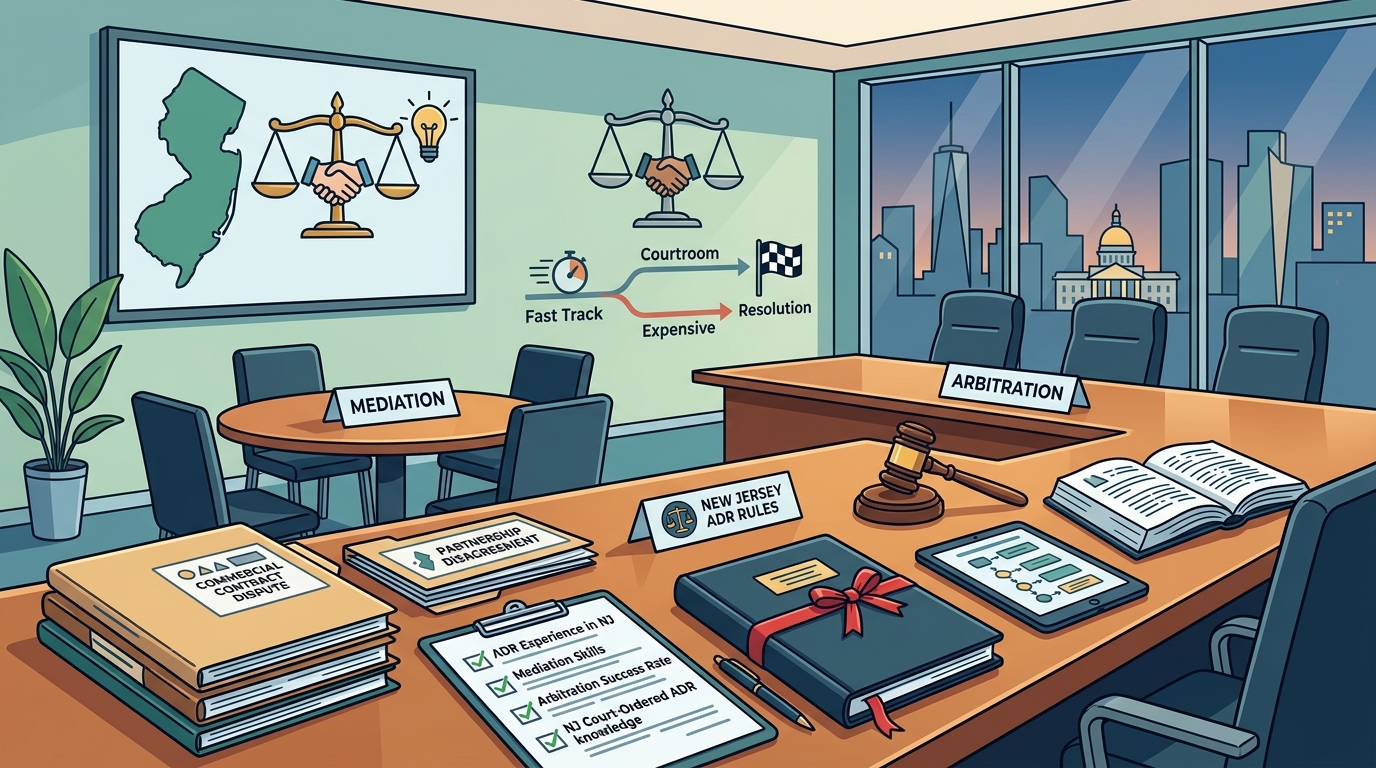
Cost and Time Advantages
| Factor | Traditional Litigation | Mediation | Arbitration |
|---|---|---|---|
| Average Duration | 18-36 months | 1-3 months | 6-12 months |
| Relative Cost | High | Low | Moderate |
| Confidentiality | Public record | Confidential | Generally private |
| Control Over Outcome | Judge/jury decides | Parties decide | Arbitrator decides |
| Binding Result | Yes (with appeal rights) | Only if parties agree | Yes (limited appeal) |
Key Qualifications to Look For
Not every litigator is suited for ADR. The skills required to negotiate a mediated settlement differ significantly from those needed at trial. Here is what matters most.
ADR-Specific Experience
Look for attorneys who have served as both advocates and neutrals. Firms like LoFaro & Carver's ADR practice staff retired Superior Court judges alongside seasoned litigators, giving clients perspective from both sides of the table. An attorney who has sat as an arbitrator understands how panels weigh evidence and frame decisions.
Subject-Matter Knowledge
ADR spans employment disputes, construction claims, real estate conflicts, and corporate governance battles. Your lawyer should have direct experience in the substantive area of your dispute. If you are resolving a business or corporate matter, choose counsel familiar with commercial contracts, fiduciary duties, and partnership agreements.
Court Certifications and Professional Affiliations
In New Jersey, mediators can be qualified by the Supreme Court pursuant to Rule 1:40. Membership in organizations such as the American Arbitration Association (AAA) or the New Jersey State Bar Association's Dispute Resolution Section signals professional commitment and ongoing training.
Mediation vs. Arbitration: Matching the Lawyer to the Process
Mediation is a party-centered process focused on communication and creative problem-solving. Your attorney should excel at negotiation and relationship management. Arbitration resembles a condensed trial; you need someone comfortable presenting evidence, examining witnesses, and crafting persuasive written submissions.
If your contract contains a mandatory arbitration clause, confirm that your attorney has handled cases before the specific forum named, whether that is the AAA, FINRA, or a court-annexed panel. For voluntary mediation, prioritize lawyers who have a track record of reaching favorable settlements without escalating to litigation. Our step-by-step ADR attorney decision framework offers a deeper dive into matching process to practitioner.
Questions to Ask Before Hiring an ADR Lawyer
Walking into a consultation without a checklist wastes everyone's time. Use these questions to vet candidates quickly.
- How many mediations or arbitrations have you handled in the last two years? Recent, active experience matters more than a long but dated resume.
- Have you served as a neutral? Dual-role experience provides strategic insight.
- What is your fee structure for ADR proceedings? Some lawyers bill hourly; others offer flat fees for mediation sessions.
- Do you have relationships with preferred neutrals in New Jersey? Knowing which mediators or arbitrators are best suited to a case type is a significant advantage.
- Can you share references from past ADR clients? Testimonials and case studies reveal real-world effectiveness.
For corporate disputes specifically, review our comparison of corporate dispute resolution options in New Jersey to understand which process fits your situation before your first meeting.
Red Flags When Choosing an ADR Attorney
Avoid lawyers who treat ADR as a mere formality before "real" litigation. Other warning signs include a refusal to discuss fees upfront, no verifiable ADR case history, and a combative negotiation style that works against the collaborative nature of mediation. An attorney unfamiliar with New Jersey's Complementary Dispute Resolution rules may also miss procedural deadlines that cost you leverage.
It is equally important to confirm the attorney is admitted to practice in New Jersey. Out-of-state lawyers may participate in ADR under certain conditions, but New Jersey's Rules of Professional Conduct 5.5 impose limits. Verify bar status through the firm's attorney profiles or the New Jersey Courts attorney search tool.
Key Takeaways
- ADR is a collection of dispute resolution methods, including mediation, arbitration, and early neutral evaluation, that operate outside of traditional courtroom litigation.
- New Jersey courts mandate arbitration for many civil actions under Rule 4:21A, making ADR experience essential for litigants.
- Prioritize attorneys who have served as both advocates and neutrals for the deepest strategic perspective.
- Match the lawyer to the process: negotiation skills for mediation, trial-like advocacy for arbitration.
- Verify Supreme Court mediator qualifications and professional affiliations such as AAA membership.
- Ask about fee structures, recent caseloads, and relationships with local neutrals before signing a retainer.
- Avoid attorneys who lack verifiable ADR experience or treat the process as a stepping stone to litigation.
Frequently Asked Questions
What is the difference between mediation and arbitration in New Jersey?
Mediation is a voluntary, non-binding process in which a neutral third party facilitates negotiation between the disputing sides. Arbitration is a more formal proceeding where an arbitrator hears evidence and issues a decision that is often binding and carries limited appeal rights.
Do I need a lawyer for ADR in New Jersey?
You are not legally required to have a lawyer in most ADR proceedings. However, having experienced counsel protects your rights, helps you evaluate settlement offers, and ensures any agreement is enforceable.
How much does ADR cost compared to litigation?
ADR is typically far less expensive than a full trial. Mediation sessions may cost a few thousand dollars, while arbitration costs fall between mediation and litigation. The exact amount depends on case complexity, the neutral's fees, and attorney costs.
How do I find a qualified ADR lawyer in New Jersey?
Start by reviewing firm practice area pages, such as the ADR services offered by LoFaro & Carver. Check for retired judges on the team, Supreme Court mediator qualifications, and AAA panel membership.
Can an arbitration decision be appealed?
In binding arbitration, appeal rights are extremely limited. New Jersey courts will generally only vacate an award in cases of fraud, evident partiality, or arbitrator misconduct under N.J.S.A. 2A:23B.
Is ADR confidential in New Jersey?
Yes. New Jersey's Uniform Mediation Act (N.J.S.A. 2A:23C) establishes privilege and confidentiality protections for communications made during mediation. Arbitration proceedings are also generally private, though the enforceability of the award becomes public record if confirmed by a court.
What types of disputes can be resolved through ADR?
ADR applies to a wide range of matters, including commercial contract disputes, employment claims, real estate conflicts, construction disagreements, family law issues, and partnership or shareholder disputes.
How long does ADR take in New Jersey?
Mediation can conclude in a single session or within a few weeks. Arbitration typically takes six to twelve months, depending on complexity. Both are substantially faster than traditional litigation, which often stretches beyond two years.
Ready to Resolve Your Dispute?
Choosing the right ADR lawyer is the single most important decision you will make before entering mediation or arbitration. If you are dealing with a business conflict, real estate disagreement, or any civil dispute in New Jersey, experienced counsel can save you time, money, and stress. Contact the team at LoFaro & Carver to schedule a consultation and find out which ADR path is right for your situation.