

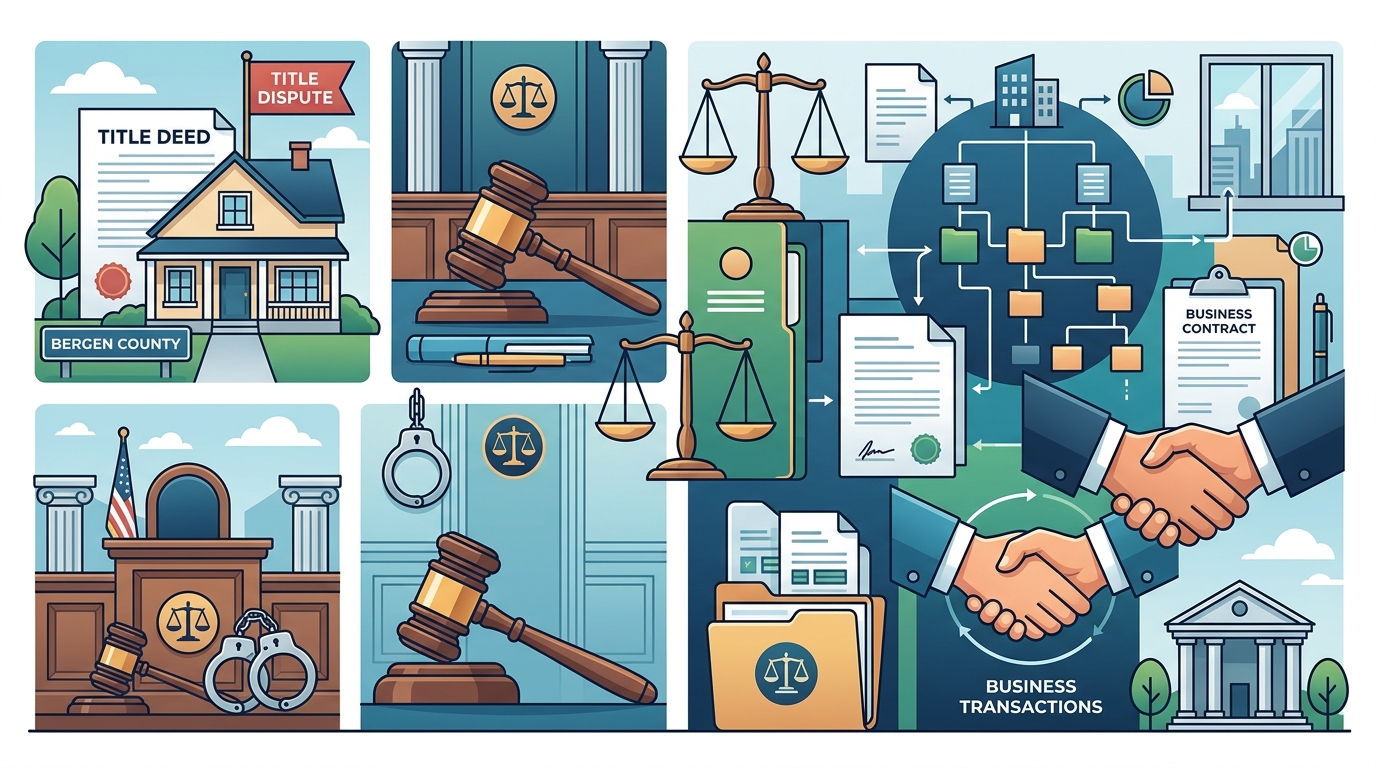
Choosing a law firm in New Jersey means understanding exactly which services apply to your situation — whether you are a homeowner facing a title dispute in Bergen County or a mid-market corporation restructuring its entity after a merger. This guide walks through every major practice area that New Jersey firms handle, organized by who the service is for and what it actually involves in practice.
Transactional Services: Forming, Buying, and Selling Businesses
One of the most foundational services a New Jersey law firm provides is guiding entrepreneurs and corporations through business transactions. This encompasses entity formation, mergers and acquisitions, contract drafting, and partnership agreements.
Entity Selection and Formation
Before a business opens its doors in New Jersey, it must select the right legal structure. Common options include LLCs, S-corporations, and C-corporations. Each structure carries distinct tax implications: an S-corporation is taxed only at the shareholder level, a C-corporation faces taxation at both the corporate and shareholder levels, and an LLC is taxed at the member level. An experienced attorney helps founders weigh liability protection, management flexibility, and long-term growth plans against the tax consequences of each form.
New Jersey treats a business entity as legally separate from those who control it — including owners, members, and shareholders. This separation means personal assets are generally shielded in a liability event, but maintaining that protection requires strict compliance with formalities such as filing articles of incorporation, adopting corporate bylaws, and holding required shareholder meetings.
Mergers, Acquisitions, and Business Sales
Whether you are expanding through an acquisition or exiting through a sale, these transactions require careful due diligence. Buyers should review the target company's tax history through IRS filings to establish a clear picture of profitability and liabilities, and verify that no liens or pending lawsuits exist against the business. An attorney then drafts or negotiates the purchase and sale agreement, addressing earnout provisions, escrow terms, and post-closing obligations.
Transactions in New Jersey frequently involve ancillary complexities such as Section 1031 like-kind exchanges, lease negotiations for multiple locations, and employment or equity partnership issues between merging parties. A firm like LoFaro Carver LLC, with deep transactional experience across business and real estate disciplines, is positioned to handle these interrelated components under one roof.
Commercial and Civil Litigation
When business relationships break down, New Jersey law firms step into the courtroom — or increasingly, the virtual hearing room — on behalf of both individuals and corporations. Commercial litigation encompasses contract disputes, shareholder and partnership disagreements, business torts, unfair competition claims, consumer fraud actions, and intellectual property conflicts.
What Commercial Litigation Covers in NJ
New Jersey business litigation spans a remarkably wide range of subjects. Attorneys in this field routinely handle matters including director and officer liability, oppressed minority shareholder claims, antitrust and RICO issues, tortious interference, and employment disputes. The state's Consumer Fraud Act is particularly expansive and is frequently invoked in both individual and corporate disputes.
Full-service firms maintain litigation teams that appear in state and federal courts at both the trial and appellate levels, as well as before administrative tribunals. Having attorneys who understand both the transactional backstory and courtroom strategy is a significant advantage — a firm that drafted the operating agreement is already familiar with the terms at issue in a partnership dispute.
Corporate and Commercial Litigation at LoFaro Carver LLC
LoFaro Carver LLC brings over 110 years of combined experience navigating the New Jersey court system. Their seasoned practitioners handle corporate and commercial litigation with the blend of legal acumen and business savvy that is critical to resolving high-stakes disputes efficiently. Rather than treating litigation as an isolated event, the firm leverages its cross-disciplinary knowledge in business transactions and real estate to develop litigation strategies grounded in the full commercial context of a dispute.
Real Estate Law for Buyers, Sellers, and Developers
Real estate touches almost every type of client a New Jersey law firm represents. Individuals need attorneys for residential closings; corporations need counsel for commercial acquisitions, site plan approvals, and construction contracts.
Residential Real Estate in New Jersey
New Jersey's residential purchase process includes a mandatory three-day attorney review period, during which both the buyer and seller can consult an attorney to revise contract terms or cancel the agreement without penalty. After the review period, parties proceed with title searches, inspections, and negotiations about repairs or credits. While the state does not legally require an attorney for closing, most buyers and sellers choose to retain one for added protection.
Local requirements vary by municipality. Cities like Newark, for example, may require property certifications such as smoke detector inspections and certificates of occupancy before closing. A New Jersey real estate attorney familiar with county-level procedures — from Essex County tax assessments to Hudson County permit timelines — helps prevent delays and ensures compliance.
Commercial Real Estate and Development
Commercial transactions are significantly more complex. They often involve zoning and land use applications, environmental due diligence, complex financing structures, and negotiations with municipal planning boards. Attorneys handle site plan approvals, zoning compliance, easement agreements, and title dispute resolution. For development projects, counsel coordinates with architects, construction contractors, and lenders to keep projects on schedule and within legal requirements.
LoFaro Carver LLC represents clients in business and real estate transactions across New Jersey, providing end-to-end counsel from contract negotiation through closing and beyond. Their experience with both transactional and litigation aspects of real estate means they can spot potential dispute triggers during the deal phase and structure agreements to minimize future risk.
Criminal and DWI Defense
Criminal defense is a critical service for individuals — and sometimes for corporate officers — in New Jersey. This practice area covers everything from municipal court proceedings and traffic violations to serious indictable offenses and white-collar criminal charges.
DWI Defense in New Jersey
New Jersey treats DWI as a traffic offense rather than a criminal charge, but the consequences are severe: license suspension, ignition interlock requirements, fines, and potential jail time for repeat offenders. DWI defense attorneys examine the circumstances of the stop, the calibration and administration of breathalyzer tests, and whether field sobriety tests were conducted in accordance with established protocols.
White-Collar and Corporate Criminal Defense
Corporations and their officers may face criminal exposure for fraud, embezzlement, regulatory violations, or environmental crimes. Defense in these cases requires attorneys who understand both the criminal justice system and the underlying business operations. LoFaro Carver LLC offers criminal and DWI defense as part of its full-service practice, ensuring that clients facing criminal allegations have access to attorneys with the courtroom experience and business understanding necessary for an effective defense.
Alternative Dispute Resolution
Not every conflict needs to reach a courtroom. Alternative dispute resolution (ADR) — primarily mediation and arbitration — has become an increasingly important tool in New Jersey civil practice. ADR offers several advantages: reduced costs, faster timelines, greater confidentiality, and the ability for parties to maintain a business relationship after the dispute is resolved.
When ADR Makes Sense
ADR is particularly effective in partnership and shareholder disputes, contract disagreements, construction defect claims, and commercial landlord-tenant conflicts. New Jersey courts increasingly encourage or require mediation before trial, making it a practical reality that parties and their attorneys must be prepared for.
LoFaro Carver LLC includes alternative dispute resolution among its core practice areas, giving clients the option to resolve matters outside of traditional litigation when it serves their interests. Their attorneys function as both advocates within ADR proceedings and as neutral mediators when engaged by outside parties.
Regulatory Compliance and Emerging Legal Obligations
New Jersey's regulatory environment is evolving rapidly, and businesses that do not keep pace face real consequences. Several recent legislative changes illustrate why ongoing legal counsel is essential.
Pay Transparency Requirements
New Jersey employers with 10 or more employees over a 20-calendar-week period must now include salary ranges and general benefit information in all job postings. Non-compliance exposes employers to enforcement actions and reputational risk. Attorneys help companies update their posting practices, train HR teams, and establish internal compliance procedures.
New Jersey Data Protection Act
The NJDPA, effective January 15, 2025, imposes data privacy obligations on businesses that process the personal data of New Jersey residents. Controllers must honor global opt-out signals, and a 30-day cure period for violations runs through July 15, 2026. After that deadline, the Attorney General may take enforcement actions. Businesses with digital operations need legal counsel to audit their data practices and implement required consumer rights mechanisms.
Corporate Business Tax Changes
Corporations with taxable net income over $10 million allocated to New Jersey face a 2.5% corporate transit fee surtax, increasing their top effective rate to 11.5%. Additionally, proposed amendments to Corporation Business Tax regulations address the digital economy — businesses with more than $100,000 in New Jersey-source revenue or 200-plus transactions may be subject to CBT even without a physical presence in the state. Companies operating across state lines should reassess their apportionment strategies and entity structures with qualified legal and tax counsel.
AI and Technology Incentives
On the incentive side, New Jersey has created the Next New Jersey Program — AI, a $500 million tax credit initiative to attract AI companies and data centers. Eligible businesses must invest at least $100 million, create 100 full-time jobs paying at least 120% of the county median wage, and partner with a New Jersey university or research institution. For companies considering a significant investment in the state, an attorney can help evaluate eligibility and structure the application.
Personal Legal Services for Individuals
Beyond business matters, New Jersey law firms serve individuals across a wide range of personal legal needs.
Estate Planning and Probate
Estate planning attorneys help individuals draft wills, establish trusts, designate powers of attorney, and create advance healthcare directives. When disputes arise — such as claims of undue influence or challenges to the validity of a will — estate litigation attorneys represent heirs, executors, and beneficiaries in Surrogate's Court and the Chancery Division.
Family Law
Divorce, child custody, child support, alimony, and domestic violence matters all fall under family law. Many New Jersey firms now offer collaborative divorce and mediation services, which can lead to faster and less adversarial resolutions compared to traditional litigation.
Personal Injury
Individuals injured due to another party's negligence — whether in auto accidents, slip-and-fall incidents, or medical malpractice situations — turn to personal injury attorneys to recover compensation. New Jersey follows a modified comparative negligence standard, meaning a plaintiff can recover damages as long as they are less than 51% at fault.
Landlord-Tenant Disputes
Both landlords and tenants in New Jersey have specific statutory rights and obligations. Attorneys handle eviction proceedings, security deposit disputes, lease negotiations, habitability complaints, and challenges to rent increases in municipalities with rent control ordinances.
How to Choose the Right NJ Law Firm for Your Needs
With hundreds of firms practicing throughout New Jersey, selecting the right one depends on several factors:
- Breadth of practice areas: A full-service firm can handle interconnected issues — for example, a business acquisition that involves real estate, employment contracts, and tax planning — without requiring you to coordinate multiple firms.
- Local court experience: New Jersey's court system has unique procedures and judicial preferences that vary by county. Firms with extensive experience in the specific venue where your matter will be heard have a practical advantage.
- Industry knowledge: The best attorneys combine legal expertise with genuine understanding of your business or personal situation. Look for a firm whose attorneys have credentials, hands-on experience, and both legal and business acumen.
- Availability of ADR services: If your dispute can be resolved through mediation or arbitration, a firm with dedicated ADR practitioners saves time and cost.
- Track record and reputation: Peer recognition, published case results, and client testimonials all provide insight into a firm's capabilities.
LoFaro Carver LLC checks each of these boxes. As a full-service firm with over 110 years of combined experience, they represent individuals, corporations, and entrepreneurs across business transactions, real estate, corporate litigation, criminal defense, and alternative dispute resolution — all rooted in deep knowledge of the New Jersey legal landscape.
Key Takeaways
- New Jersey law firms serve both individuals and corporations across transactional, litigation, regulatory, and personal legal matters.
- Entity formation, mergers and acquisitions, and contract drafting are foundational services for businesses of every size.
- Commercial litigation in NJ covers shareholder disputes, business fraud, consumer fraud, antitrust, and much more.
- Real estate transactions in New Jersey include a mandatory three-day attorney review period for residential purchases.
- Recent regulatory changes — including pay transparency rules, the NJDPA, and corporate tax surtaxes — require proactive legal compliance.
- ADR is increasingly favored in New Jersey courts and can resolve disputes faster and more cost-effectively than litigation.
- A full-service firm like LoFaro Carver LLC provides the advantage of integrated counsel across multiple practice areas and deep familiarity with the NJ court system.
Frequently Asked Questions
What types of legal services do New Jersey law firms provide to individuals?
New Jersey law firms provide individuals with services including criminal and DWI defense, real estate transaction support, estate planning and probate, family law (divorce, custody, support), personal injury representation, and landlord-tenant dispute resolution. Full-service firms like LoFaro Carver LLC handle multiple practice areas so individuals can receive coordinated counsel.
What corporate legal services are available in New Jersey?
Corporate services include business formation and entity structuring, mergers and acquisitions, commercial and shareholder litigation, contract drafting and negotiation, regulatory compliance, tax planning, real estate transactions, employment law, and alternative dispute resolution. Firms also help with emerging obligations like data privacy compliance under the NJDPA.
Do I need a lawyer to buy a house in New Jersey?
New Jersey does not legally require an attorney for residential real estate closings. However, the state's residential purchase process includes a mandatory three-day attorney review period, and most buyers and sellers choose to have an attorney represent them for protection during the transaction. An attorney can review and amend contract terms, conduct title searches, and ensure compliance with local municipal requirements.
What is alternative dispute resolution and when should I consider it?
Alternative dispute resolution (ADR) includes mediation and arbitration — methods for resolving legal disputes outside of a traditional courtroom trial. ADR is particularly effective for partnership disputes, contract disagreements, and commercial conflicts. It typically costs less, resolves faster, and allows parties to maintain confidentiality. New Jersey courts increasingly encourage or mandate mediation before trial.
How do I choose the right law firm in New Jersey?
Consider the firm's breadth of practice areas, experience in your specific county's courts, industry knowledge, availability of ADR services, and overall reputation. A full-service firm with deep local experience — such as LoFaro Carver LLC, which has over 110 years of combined experience in the New Jersey court system — can handle interconnected legal matters without requiring you to coordinate multiple attorneys at different firms.
What new regulatory requirements should New Jersey businesses know about?
Key recent changes include mandatory salary range disclosures in job postings for employers with 10+ employees, the New Jersey Data Protection Act requiring data privacy compliance, a 2.5% corporate transit fee surtax for corporations with over $10 million in NJ-allocated taxable income, updated Corporation Business Tax rules affecting digital economy businesses, and the $500 million Next New Jersey Program — AI tax credit initiative.