

Corporate disputes can threaten your business relationships, drain financial resources, and stall growth. Whether you are facing a shareholder disagreement, a breach of contract, or a partnership conflict, understanding your resolution options under New Jersey law is essential. The good news is that New Jersey offers several effective pathways for resolving corporate disputes, from informal negotiation to formal courtroom litigation. In this guide, we break down each method, compare their costs and timelines, and help you determine which approach best fits your situation.
Common Types of Corporate Disputes in NJ
Corporate disputes in New Jersey span a wide range of issues. Shareholder disputes frequently arise over dividends, executive appointments, or the direction of the company. Partnership conflicts can stem from financial stress, personality clashes, or divergent business goals.
Breach of contract claims are among the most common triggers for commercial litigation. Other frequent disputes involve breach of fiduciary duty, unfair competition, and disagreements related to construction projects or commercial real estate transactions.
Direct Negotiation
Negotiation is the simplest and most informal method of resolving corporate disputes. It involves the disputing parties communicating directly, often through their attorneys, to reach a mutually acceptable agreement without involving a third-party neutral.
Direct negotiation preserves business relationships and keeps costs low. It works best when both parties have a genuine interest in reaching a resolution and the power dynamic between them is relatively balanced. Having experienced business and corporate law counsel at the table significantly increases the chances of a favorable outcome.
Mediation: A Cost-Effective First Step
Mediation is a voluntary, non-binding process in which a neutral third-party mediator helps the disputing parties reach a settlement. The mediator does not make a decision; instead, they facilitate communication and help each side understand the other's position.
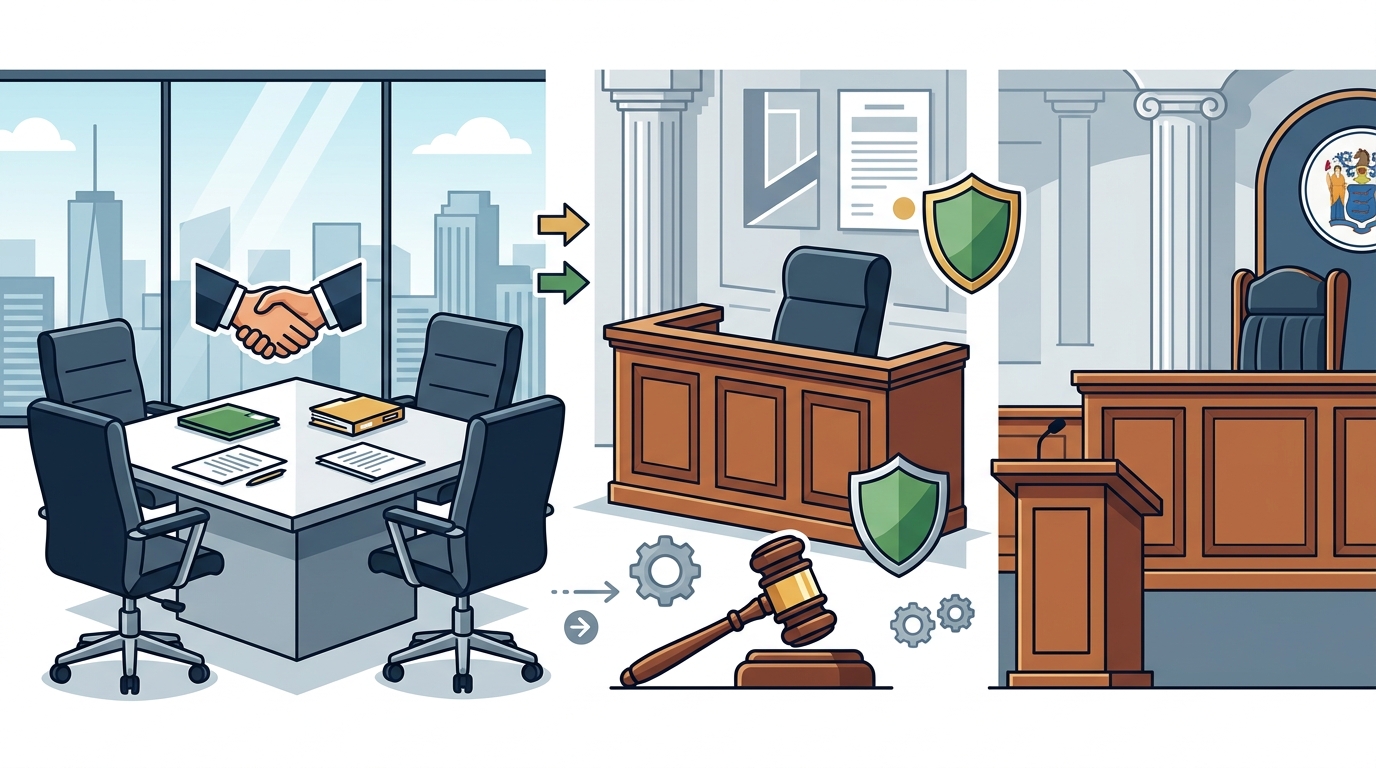
Why NJ Courts Encourage Mediation
The New Jersey Supreme Court requires parties in certain legal proceedings to submit to court-ordered mediation before appearing before a judge, according to the NJ Division of Consumer Affairs. This reflects a statewide recognition that mediation saves time, reduces court congestion, and often leads to outcomes both parties can accept.
When Mediation Works Best
Mediation is ideal for disputes where preserving the business relationship matters. It is also effective for shareholder disagreements and partnership conflicts where the parties want a confidential resolution. LoFaro Carver LLC provides alternative dispute resolution services that include customized, in-person, virtual, and hybrid mediation sessions.
Arbitration: Binding and Efficient
Arbitration is a process in which the disputing parties present evidence and arguments to a neutral arbitrator (or panel), who then issues a binding decision. Unlike mediation, the arbitrator's ruling is generally final and enforceable in court.
Key Advantages of Arbitration
Arbitration typically moves faster than courtroom litigation because discovery is limited and there is no jury trial. It also offers greater privacy, which is critical for businesses that want to keep sensitive financial or operational details out of the public record.
Contractual Arbitration Clauses
Many corporate disputes are subject to arbitration because the parties' shareholder agreement, partnership agreement, or commercial contract includes an arbitration clause. If your business agreements do not yet include a dispute resolution clause, an experienced attorney can draft one that specifies mediation, arbitration, or a tiered approach. Learn more about proactive corporate planning through our business and commercial litigation practice.
Litigation in New Jersey Courts
Litigation is the formal process of resolving a dispute through the New Jersey court system. When negotiation, mediation, and arbitration fail or are not appropriate, litigation may be the only path to a binding resolution.
Where Corporate Cases Are Heard
New Jersey's Superior Court has two primary divisions for corporate disputes. The Law Division handles cases seeking monetary damages, while the Chancery Division can award equitable relief such as restraining orders, forced buyouts, or corporate dissolutions. For complex matters, the Complex Business Litigation Program (CBLP) assigns a dedicated judge to manage cases with an amount in controversy of at least $200,000.
Governing Statutes
The New Jersey Business Corporation Act (NJBCA) is the primary statute governing corporate operations and disputes in the state. It provides remedies including forced buyouts, injunctive relief, and derivative suits. Partnership disputes are governed by the Uniform Partnership Act (UPA), which outlines procedures for dissolution and fiduciary responsibilities.
Comparing Your Dispute Resolution Options
Choosing the right resolution method depends on your priorities: speed, cost, confidentiality, and whether you need a binding outcome. The table below summarizes the key differences.
| Method | Binding? | Typical Timeline | Relative Cost | Confidentiality | Best For |
|---|---|---|---|---|---|
| Negotiation | No (unless agreement reached) | Days to weeks | Low | High | Early-stage disputes, relationship preservation |
| Mediation | No (unless settlement signed) | Weeks to months | Low to moderate | High | Shareholder or partnership conflicts |
| Arbitration | Yes | Months | Moderate | High | Contract disputes with arbitration clauses |
| Litigation (Law Division) | Yes | 1-3 years | High | Low (public record) | Monetary damage claims |
| Litigation (Chancery Division) | Yes | 1-3 years | High | Low (public record) | Equitable relief, buyouts, dissolutions |
| CBLP | Yes | Expedited | High | Low (public record) | Complex commercial cases over $200K |
Key Takeaways
- New Jersey offers multiple paths for resolving corporate disputes, including negotiation, mediation, arbitration, and litigation.
- Mediation is a non-binding, cost-effective process that NJ courts actively encourage before trial.
- Arbitration is a binding alternative that typically resolves disputes faster and more privately than courtroom litigation.
- The NJBCA and the Uniform Partnership Act provide the legal framework for corporate and partnership dispute remedies in New Jersey.
- New Jersey's Complex Business Litigation Program provides dedicated judicial management for commercial cases exceeding $200,000.
- Including dispute resolution clauses in corporate agreements can prevent costly courtroom battles later.
- Working with attorneys who have deep experience in both ADR and litigation gives you the flexibility to pursue the best strategy for your specific dispute.
Frequently Asked Questions
What is alternative dispute resolution (ADR)?
Alternative dispute resolution (ADR) is a collection of methods for resolving legal disputes outside of a traditional courtroom trial. The most common forms are mediation and arbitration. ADR is generally faster, less expensive, and more private than litigation.
Is mediation legally binding in New Jersey?
No, mediation itself is not binding. However, if the parties reach a settlement agreement during mediation and sign it, that agreement becomes a legally enforceable contract.
What is the difference between arbitration and mediation?
In mediation, a neutral mediator facilitates discussion but does not decide the outcome. In arbitration, a neutral arbitrator hears evidence and issues a binding, generally unappealable decision.
When should I consider litigation instead of ADR?
Litigation may be necessary when one party refuses to participate in ADR, when you need equitable relief like an injunction or forced buyout, or when the dispute involves fraud or bad faith that requires judicial intervention.
What is the Complex Business Litigation Program (CBLP)?
The CBLP is a New Jersey Superior Court program that assigns a dedicated judge to manage complex commercial and construction cases. Cases are automatically assigned if the amount in controversy is at least $200,000 and the parties designate the case as complex.
Can I require arbitration in my shareholder agreement?
Yes. Including an arbitration clause in your shareholder or operating agreement is a common and enforceable practice in New Jersey. This clause specifies that disputes must go through arbitration before or instead of litigation.
How long does corporate litigation take in New Jersey?
Corporate litigation in New Jersey can take anywhere from one to three years or longer, depending on the complexity of the case, the volume of discovery, and the court's schedule. ADR methods typically resolve matters in weeks to months.
Why should I hire a law firm experienced in both ADR and litigation?
A firm with experience in both areas can evaluate your dispute and recommend the most effective path. If ADR fails, your attorneys are already prepared to transition to litigation without losing time or strategic advantage. LoFaro Carver LLC offers both ADR and litigation services backed by over 110 years of combined experience.
Get Help Resolving Your Corporate Dispute
If your business is facing a corporate dispute in New Jersey, the attorneys at LoFaro Carver LLC can help you evaluate your options and pursue the most effective resolution strategy. With seasoned practitioners experienced in negotiation, mediation, arbitration, and courtroom litigation, we are prepared to protect your interests at every stage. Contact LoFaro Carver LLC today to schedule a consultation.