
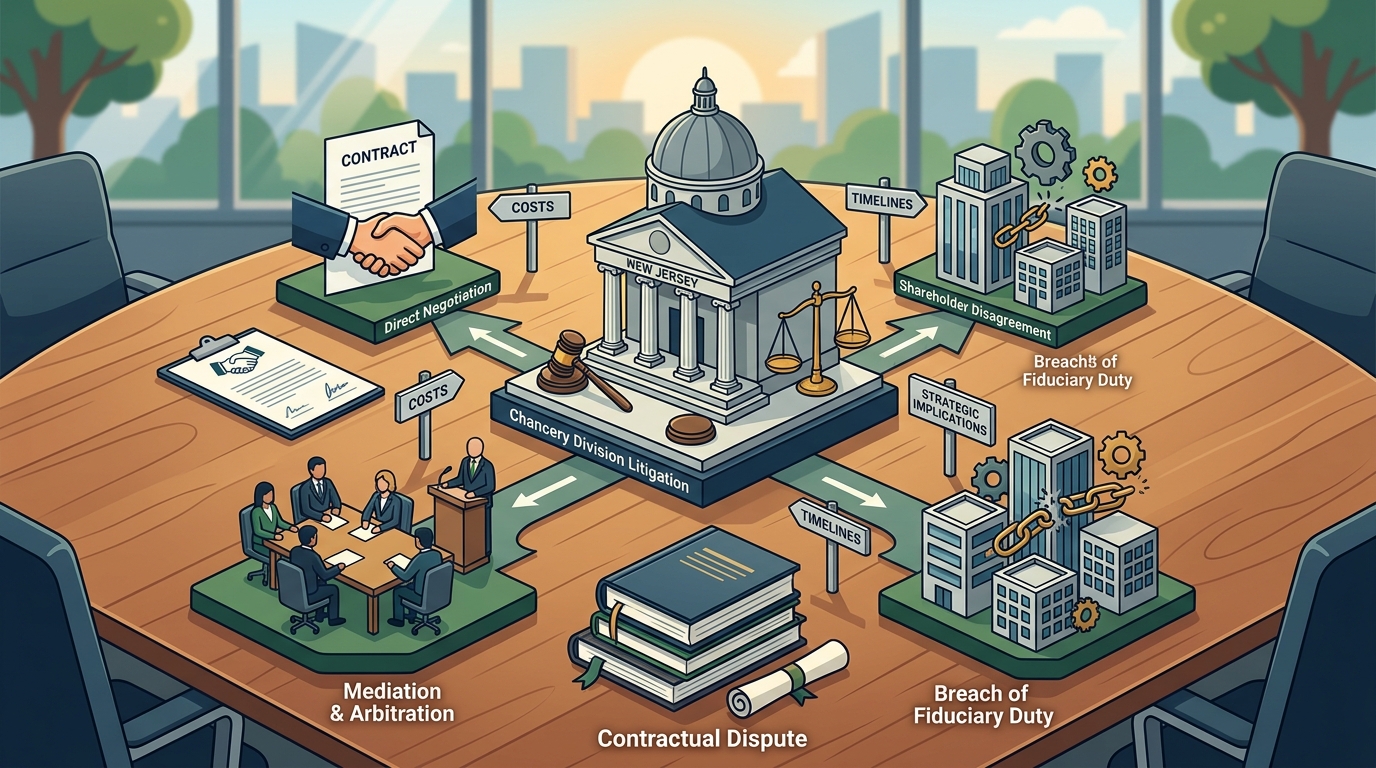
Corporate disputes can threaten profitability, damage business relationships, and stall growth. Whether you are facing a shareholder disagreement, a breach of fiduciary duty claim, or a contract conflict, knowing every resolution path available under New Jersey law is essential. From direct negotiation to full-blown Chancery Division litigation, each option carries distinct costs, timelines, and strategic implications. This guide breaks down the best options for resolving corporate disputes in New Jersey so you can choose the right approach for your situation and protect what you have built.
Common Types of Corporate Disputes in NJ
Corporate disputes in New Jersey span a wide range of issues. Shareholder and LLC member disagreements are among the most frequent, often involving the division of profits, management control, or minority shareholder oppression. The New Jersey Oppressed Minority Shareholder Act specifically protects minority shareholders in closely held corporations with twenty-five or fewer shareholders.
Breach of fiduciary duty is another major source of conflict. A breach of fiduciary duty occurs when a corporate officer or director acts in self-interest rather than in the best interest of the company and its stakeholders. Other common disputes include breach of contract, trade secret misappropriation, partnership dissolutions, and commercial lease conflicts.
Direct Negotiation
Direct negotiation is the simplest and most cost-effective starting point for resolving a corporate dispute. It involves the disputing parties, usually with their attorneys, attempting to reach a voluntary agreement without third-party intervention.
When Negotiation Works Best
Negotiation is most effective when the business relationship is worth preserving and both sides are willing to compromise. It works well for disputes over profit distributions, management roles, or operational disagreements where the underlying partnership remains viable.
Limitations
Without a neutral third party, power imbalances can derail negotiations. If trust has broken down entirely, alternative dispute resolution or litigation may be necessary.
Mediation
Mediation is a voluntary, non-binding process in which a neutral third party helps disputing sides reach a mutually acceptable settlement. The mediator does not decide the case but instead facilitates communication and helps parties identify common ground.
How Mediation Works in NJ
In New Jersey, courts frequently order civil parties to mediate before setting a case for trial. Parties select a mediator, often a retired judge or experienced attorney, who meets with both sides in joint sessions and private caucuses. The process is confidential, which protects sensitive business information from public disclosure.
Advantages of Mediation
Mediation typically costs a fraction of what litigation requires and resolves faster. It also gives parties direct control over the outcome, unlike a judge or jury verdict. For business owners who want to maintain working relationships, mediation preserves goodwill in ways that adversarial proceedings cannot. At LoFaro Carver LLC, our ADR practice provides efficient, cost-effective, and impartial dispute resolution services led by experienced attorneys and retired judges.
Arbitration
Arbitration is a private dispute resolution process in which a neutral arbitrator hears evidence and issues a binding decision that courts will enforce. Unlike mediation, the arbitrator acts as both judge and jury.
Binding vs. Non-Binding Arbitration
Most corporate arbitration in New Jersey is binding, meaning the decision is final with very limited grounds for appeal. Non-binding arbitration exists but is less common in corporate settings. Many shareholder agreements and LLC operating agreements contain mandatory arbitration clauses administered through organizations like the American Arbitration Association (AAA).
Speed and Cost Considerations
Arbitration generally moves faster than court litigation because discovery is limited and there is no jury trial. However, arbitrator fees and AAA administrative costs can be substantial, particularly for high-value disputes. Despite these costs, many businesses prefer arbitration for its speed and finality.
Litigation in New Jersey Courts
When negotiation and ADR fail, corporate disputes proceed to the New Jersey Superior Court. Understanding which division handles your case is critical to your legal strategy.
Law Division vs. Chancery Division
The New Jersey Superior Court splits civil cases into two main divisions. The Law Division handles cases seeking monetary damages, such as breach of contract claims and collection actions. The Chancery Division handles cases requiring equitable relief, such as injunctions, forced buyouts, corporate dissolutions, and restraining orders. Most complex corporate disputes, including shareholder oppression and partnership breakups, are heard in the Chancery Division by a judge without a jury.
Federal Court
Corporate disputes may land in federal court when they involve parties from different states (diversity jurisdiction) or raise federal legal questions. Federal court tends to enforce stricter deadlines and faster case management. Your attorney can advise on whether state or federal court offers a strategic advantage for your particular matter. The business and commercial litigation team at LoFaro Carver LLC has extensive experience in both forums.
Comparison of Dispute Resolution Methods
| Method | Binding? | Typical Timeline | Relative Cost | Privacy | Best For |
|---|---|---|---|---|---|
| Negotiation | Only if agreement reached | Days to weeks | Low | Private | Early-stage or low-stakes disputes |
| Mediation | Non-binding (unless settled) | Weeks to months | Low to moderate | Confidential | Preserving business relationships |
| Arbitration | Usually binding | Months | Moderate to high | Private | Contractual clauses; faster resolution |
| Litigation (State Court) | Binding (subject to appeal) | 1-3 years | High | Public record | Complex equitable relief; shareholder oppression |
| Litigation (Federal Court) | Binding (subject to appeal) | 1-2 years | High | Public record | Diversity jurisdiction; federal claims |
Key Takeaways
- Corporate disputes in New Jersey can be resolved through negotiation, mediation, arbitration, or litigation, each with different costs and timelines.
- Mediation offers the lowest cost and preserves business relationships, making it ideal for ongoing partnerships.
- Arbitration provides a faster, binding resolution but limits your ability to appeal the decision.
- Most shareholder and LLC disputes are heard in the Chancery Division, which can order equitable remedies like forced buyouts and dissolutions.
- Well-drafted shareholder agreements and LLC operating agreements with ADR clauses can prevent costly litigation before disputes arise.
- An experienced New Jersey business and corporate law attorney can help you choose the right resolution path.
- LoFaro Carver LLC brings over 110 years of combined experience navigating the New Jersey court system and ADR processes.
Frequently Asked Questions
What is alternative dispute resolution (ADR)?
Alternative dispute resolution is a process for resolving commercial, civil, and employment disputes without a conventional courtroom trial. The two most common ADR methods are mediation and arbitration. ADR is often faster and more cost-effective than traditional litigation.
Which court handles corporate disputes in New Jersey?
Most corporate disputes are heard in the New Jersey Superior Court. Cases seeking primarily money damages go to the Law Division, while cases requiring equitable relief, such as injunctions or corporate dissolutions, are handled in the Chancery Division.
Is mediation legally binding in New Jersey?
Mediation itself is not binding. However, if both parties reach a settlement agreement during mediation, that agreement becomes a legally enforceable contract. If no agreement is reached, the parties retain their right to pursue arbitration or litigation.
Can a shareholder agreement require arbitration?
Yes. Many shareholder agreements and LLC operating agreements include mandatory arbitration clauses. When such a clause exists, disputes must generally be resolved through arbitration rather than court litigation.
What is the Chancery Division?
The Chancery Division is the equity court within New Jersey's Superior Court system. It handles matters where parties seek equitable relief beyond monetary damages, including partnership breakups, enforcement of non-compete agreements, and corporate dissolutions.
How long does corporate litigation take in New Jersey?
Corporate litigation timelines vary widely based on case complexity. In state court, cases often take one to three years from filing to resolution. Federal court tends to move somewhat faster due to stricter scheduling orders.
What types of disputes can LoFaro Carver LLC handle?
LoFaro Carver LLC handles litigation, alternative dispute resolution, business and corporate law, real estate law, and criminal defense matters throughout New Jersey.
Get Experienced Legal Counsel for Your Corporate Dispute
Choosing the right dispute resolution strategy can save your business significant time, money, and stress. Whether you need skilled mediation, aggressive litigation, or strategic legal counsel to prevent disputes before they escalate, the attorneys at LoFaro Carver LLC are ready to help. With over 110 years of combined experience and a team that includes retired Superior Court judges, we bring unmatched depth to every corporate matter. Contact LoFaro Carver LLC today to schedule a consultation and protect your business interests.