

Corporate disputes can derail even the most promising business ventures. Whether you are facing a shareholder disagreement, a breach of contract claim, or a partnership fallout, knowing how to resolve the conflict efficiently is critical. In New Jersey, business owners have several powerful options ranging from direct negotiation to full-scale courtroom litigation. This guide walks you through each path, compares costs and timelines, and helps you choose the approach that protects your interests while preserving valuable business relationships.
What Are Corporate Disputes?
A corporate dispute is a legal disagreement that arises between parties involved in a business entity, such as shareholders, partners, officers, or outside vendors. Common triggers include breach of fiduciary duty, disagreements over company direction, contract violations, and disputes related to mergers or acquisitions.
In New Jersey, corporate disputes are governed by a combination of state statutes, the New Jersey Business Corporation Act, and common law precedent developed through the Superior Court system. Because these matters often involve complex financial records and multiple stakeholders, early legal guidance from experienced business and corporate law attorneys is essential.
Negotiation: The First Line of Defense
Negotiation is a voluntary, informal process in which the disputing parties communicate directly, or through counsel, to reach an agreement without third-party intervention. It is typically the fastest and least expensive method of dispute resolution.
When Negotiation Works Best
Negotiation is most effective when both sides have a genuine interest in preserving their business relationship and the dollar amount at stake does not justify formal proceedings. Many shareholder and partnership disputes in New Jersey begin and end at the negotiation table when skilled attorneys facilitate productive dialogue.
Limitations
Without a neutral third party, power imbalances can stall talks. If one side refuses to engage in good faith, you will need to escalate to a more structured process such as alternative dispute resolution.
Mediation: Facilitated Settlement
Mediation is a structured process in which a neutral third party, the mediator, helps disputing parties identify issues and negotiate a voluntary settlement. Unlike a judge, the mediator does not impose a decision. The parties retain full control over the outcome.
New Jersey courts actively encourage mediation through their Complementary Dispute Resolution (CDR) program. Mediation offers significant advantages for corporate disputes including confidentiality, lower cost, and the ability to craft creative business solutions that a court order cannot provide.
Confidentiality and Relationship Preservation
Because mediation sessions are private, sensitive financial information stays out of the public record. This privacy makes mediation especially attractive for disputes between business partners or co-owners who may continue working together. The collaborative nature of mediation can also help maintain business relationships that would otherwise be destroyed by adversarial litigation.
Arbitration: A Private Adjudication
Arbitration is a dispute resolution process in which a neutral arbitrator hears evidence from both sides and renders a decision, which may be binding or non-binding depending on the agreement. Many commercial contracts in New Jersey include mandatory arbitration clauses.
Binding vs. Non-Binding Arbitration
In binding arbitration, the arbitrator's decision is final and enforceable through the courts. Appeals are extremely limited. In non-binding arbitration, either party may reject the decision and proceed to trial. New Jersey's court-annexed arbitration program typically uses non-binding arbitration for civil disputes.
Pros and Cons
Arbitration offers a faster resolution than litigation because discovery is limited and there is no jury trial. However, the same features that speed the process also mean reduced opportunity to uncover evidence and virtually no right of appeal. Businesses should weigh these trade-offs carefully with experienced counsel before agreeing to binding arbitration.
Litigation: Taking It to Court
Litigation is the formal process of resolving a dispute through the New Jersey Superior Court system. It involves filing a complaint, discovery, motion practice, and potentially a jury or bench trial. While litigation is the most time-consuming and expensive option, it provides the broadest discovery rights and the most enforceable remedies.
New Jersey's Superior Court, Law Division and Chancery Division each handle different types of corporate disputes. The Chancery Division is particularly important for matters involving equity, injunctions, and corporate governance. Having attorneys who understand the nuances of New Jersey commercial litigation can make a decisive difference in outcome.
When Litigation Is Necessary
Litigation may be unavoidable when injunctive relief is needed, when fraud or bad faith is alleged, or when one party refuses to participate in ADR. It is also the right path when you need to establish legal precedent or enforce statutory rights that ADR cannot address.
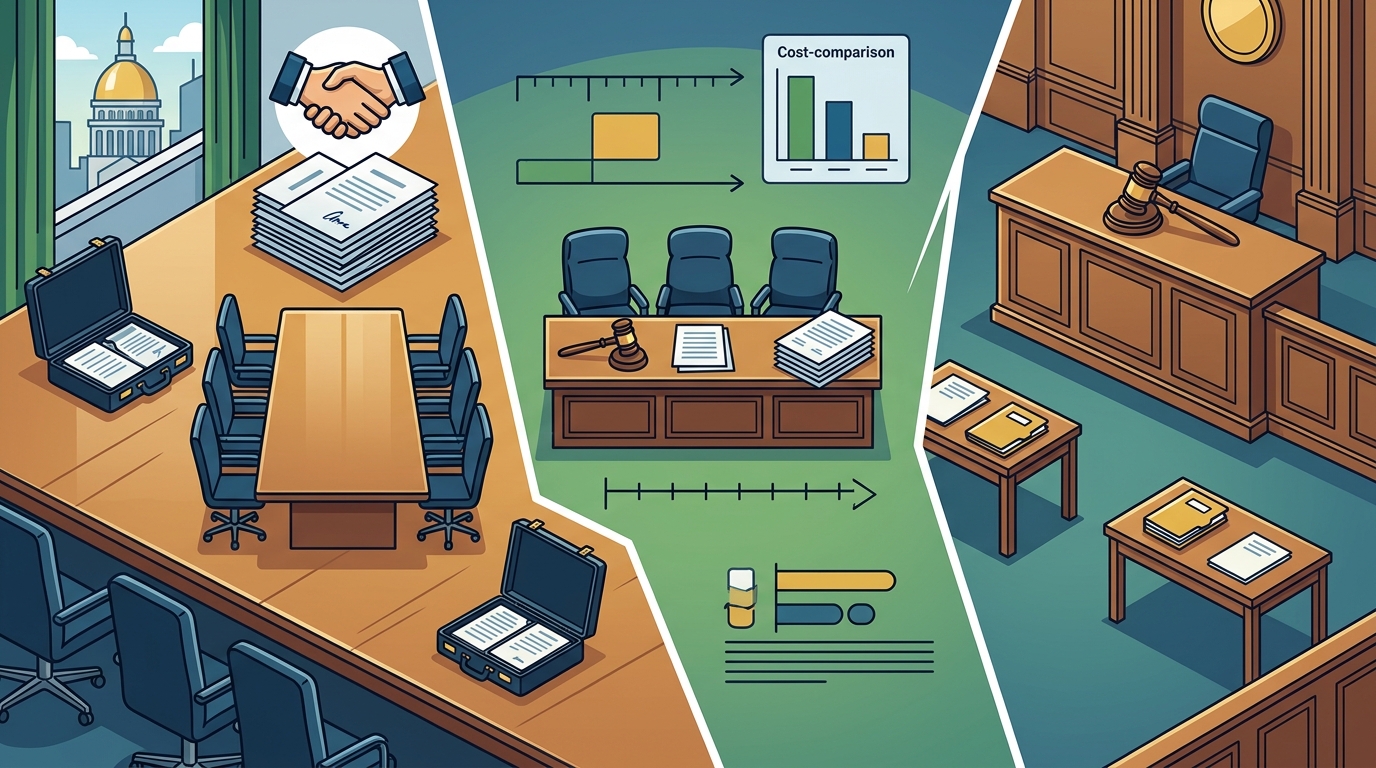
Comparing Your Dispute Resolution Options
| Factor | Negotiation | Mediation | Arbitration | Litigation |
|---|---|---|---|---|
| Cost | Low | Low to Moderate | Moderate | High |
| Timeline | Days to Weeks | Weeks to Months | Months | 1-3+ Years |
| Confidentiality | High | High | High | Low (public record) |
| Control Over Outcome | Full | Full | Limited | None |
| Binding Decision | If agreed | If agreed | Yes (if binding) | Yes |
| Discovery Rights | None | Limited | Limited | Full |
| Enforceability | Contract-based | Contract-based | Court-enforceable | Court judgment |
How to Choose the Right Path
Selecting the best dispute resolution method depends on several factors: the complexity of the issues, the relationship between the parties, the urgency of the matter, and the amount in controversy. Many New Jersey corporate disputes benefit from a tiered approach, starting with negotiation, escalating to mediation if needed, and reserving litigation as a last resort.
New Jersey also enacted the International Mediation and Arbitration Act, which provides a framework for cross-border disputes and allows mediated settlements to be converted into enforceable arbitral awards. This is particularly valuable for businesses with international operations.
Consulting a firm with deep experience in both ADR and litigation ensures you choose the right path from the start. LoFaro Carver LLC brings over 110 years of combined experience navigating the New Jersey court system, with attorneys who serve as both advocates and neutrals in alternative dispute resolution proceedings.
Key Takeaways
- Corporate disputes in New Jersey can be resolved through negotiation, mediation, arbitration, or litigation.
- Mediation and arbitration are faster and less expensive than going to trial, but each has trade-offs in discovery and appeal rights.
- Confidentiality is a major advantage of ADR methods, keeping sensitive business information out of the public record.
- Binding arbitration produces a final, court-enforceable decision with very limited grounds for appeal.
- Litigation remains necessary when injunctive relief, fraud claims, or full discovery is required.
- A tiered approach, starting with negotiation and escalating only when needed, is often the most cost-effective strategy.
- Experienced legal counsel helps you match the right resolution method to the specifics of your dispute.
Frequently Asked Questions
What is the most cost-effective way to resolve a corporate dispute in New Jersey?
Negotiation is generally the least expensive option. If direct talks fail, mediation offers a structured yet affordable alternative that avoids the high costs of litigation.
Is mediation legally binding in New Jersey?
Mediation itself is not binding. However, if both parties sign a settlement agreement during mediation, that agreement becomes an enforceable contract under New Jersey law.
Can I be forced into arbitration for a corporate dispute?
Yes. If your contract contains a mandatory arbitration clause, New Jersey courts will generally enforce it. Review your operating agreements, shareholder agreements, and vendor contracts to understand your obligations.
How long does corporate litigation take in New Jersey?
Complex commercial litigation in the New Jersey Superior Court can take one to three years or longer depending on the number of parties, the volume of discovery, and whether the case goes to trial.
What types of corporate disputes can be mediated?
Most corporate disputes can be mediated, including shareholder disagreements, breach of contract claims, partnership dissolutions, and disputes over corporate governance. Mediation is not appropriate when emergency injunctive relief is needed.
What is the difference between the Law Division and Chancery Division?
The Law Division handles monetary damages claims and jury trials. The Chancery Division handles equitable matters such as injunctions, specific performance, and corporate governance disputes. Your attorney will file in the appropriate division based on the relief sought.
Do I need a lawyer for mediation or arbitration?
While not legally required, having an experienced attorney is strongly recommended. An attorney ensures your rights are protected, helps prepare your case, and negotiates effectively on your behalf. Contact an experienced New Jersey attorney to discuss your situation.
Get Help With Your Corporate Dispute
Corporate disputes demand prompt, strategic action. Whether you need a skilled negotiator, a mediator, or a courtroom litigator, the attorneys at LoFaro Carver LLC have the experience to guide you toward the best possible resolution. With backgrounds that include service on the New Jersey Superior Court bench, our team understands dispute resolution from every angle. Schedule a consultation today by calling (201) 498-0400 or visiting our contact page.