

Resolving Corporate Disputes in New Jersey: Your Complete Guide
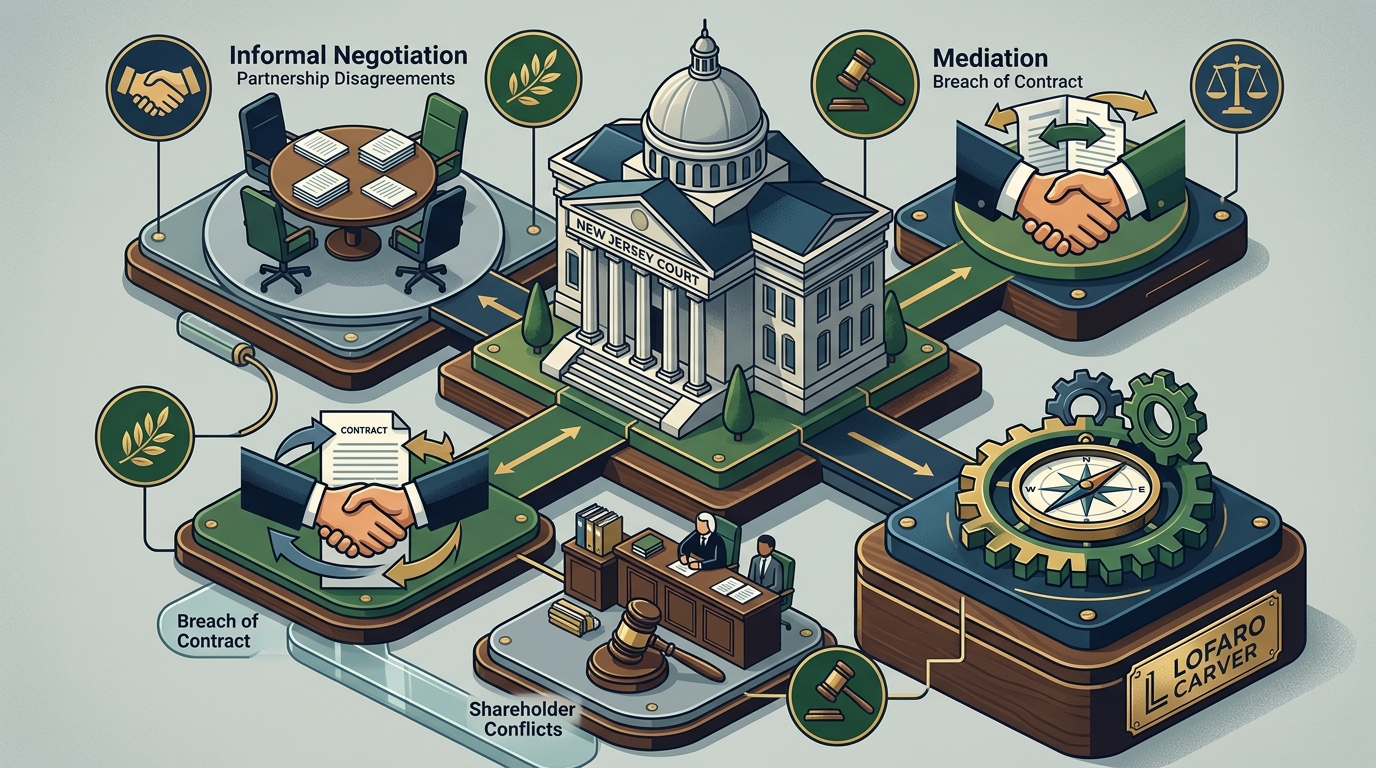
Corporate disputes can derail a thriving business overnight. Whether you are dealing with a partnership disagreement, a breach of contract claim, or a shareholder conflict, choosing the right resolution method matters. New Jersey offers several paths for resolving corporate disputes, from informal negotiation to full courtroom litigation. This guide breaks down each option so you can make an informed decision, protect your interests, and keep your business moving forward. With over 110 years of combined legal experience, the attorneys at LoFaro Carver LLC regularly help individuals and corporations navigate these choices.
What Are Corporate Disputes?
A corporate dispute is a legal conflict that arises between parties involved in a business entity, such as shareholders, partners, officers, or contracting parties. Common triggers include breach of fiduciary duty, disagreements over management decisions, contract violations, and profit-sharing conflicts.
In New Jersey, corporate disputes are governed by a combination of state statutes, common law, and the terms of the parties' agreements. Many contracts now include mandatory dispute resolution clauses that require mediation or arbitration before a lawsuit can be filed.
Direct Negotiation: The First Line of Defense
Negotiation is a voluntary, informal process where the disputing parties communicate directly, often through their attorneys, to reach a settlement. It is typically the fastest and least expensive option.
When Negotiation Works Best
Negotiation is ideal when the business relationship is ongoing and both parties want to preserve it. It also works well for lower-stakes disagreements where the cost of formal proceedings would be disproportionate.
Limitations
Without a neutral third party, power imbalances can stall talks. If the parties cannot agree, they must escalate to a more structured process like alternative dispute resolution.
Mediation: A Collaborative Path Forward
Mediation is a structured process in which a neutral third party, the mediator, helps disputing parties reach a voluntary agreement. In New Jersey, mediation is governed in part by the New Jersey Uniform Mediation Act (N.J.S.A. 2A:23C-1), which establishes confidentiality protections for mediation communications.
Key Benefits of Mediation
Mediation allows the parties to control the outcome rather than leaving the decision to a judge or jury. It is typically faster and less expensive than litigation, and it keeps sensitive business information out of the public record.
Mediation at LoFaro Carver LLC
LoFaro Carver LLC provides customized, in-person, virtual, and hybrid dispute resolution services led by experienced mediators. The firm's ADR department is chaired by Hon. Alexander H. Carver, III, J.S.C. (Ret.), a former Superior Court judge with over 45 years of litigation experience in New Jersey and New York courts.
Arbitration: Binding Resolution Without Court
Arbitration is a private adjudicative process in which one or more arbitrators hear evidence and issue a decision that is usually binding on the parties. The American Arbitration Association (AAA) administers many commercial arbitration proceedings nationwide.
How Arbitration Differs From Mediation
Unlike mediation, where the neutral facilitates agreement, the arbitrator acts as a decision-maker. Binding arbitration results in a final award with very limited grounds for appeal, making it more decisive but less flexible.
Arbitration Clauses in NJ Contracts
New Jersey courts generally enforce mandatory arbitration clauses in corporate agreements, provided they are clear and conspicuous. If your operating agreement or shareholder agreement includes an arbitration clause, you may be required to arbitrate before filing a lawsuit.
Commercial Litigation: The Courtroom Option
Commercial litigation is the process of resolving business disputes through the New Jersey court system, including the Superior Court's Law Division and Chancery Division. It involves formal pleadings, discovery, motions, and potentially a trial before a judge or jury.
When Litigation Is Necessary
Litigation may be the best option when you need emergency injunctive relief, when the opposing party refuses to engage in ADR, or when the dispute involves fraud or other claims that benefit from the public record and subpoena power of the courts. Carmine LoFaro, the firm's managing partner, brings over 30 years of experience as a litigator in both federal and state courts.
Costs and Timeline
Litigation is generally the most expensive and time-consuming option. Cases in the New Jersey Superior Court can take one to three years to reach trial, depending on complexity and court backlogs.
Comparing Your Dispute Resolution Options
| Factor | Negotiation | Mediation | Arbitration | Litigation |
|---|---|---|---|---|
| Cost | Low | Low to Moderate | Moderate | High |
| Timeline | Days to Weeks | Weeks to Months | Months | 1 to 3+ Years |
| Confidentiality | High | High (statutory) | High | Low (public record) |
| Binding? | Only if settled | Only if settled | Usually yes | Yes |
| Control Over Outcome | Full | High | Limited | None |
| Appeal Rights | N/A | N/A | Very limited | Full |
| Best For | Ongoing relationships | Complex multi-party disputes | Contract-mandated resolution | High-stakes or emergency matters |
Many corporate disputes benefit from a phased approach: start with negotiation, move to mediation if needed, and reserve litigation or arbitration as a final step. An experienced commercial dispute attorney can help you determine the right sequence for your situation.
Key Takeaways
- New Jersey offers four primary paths for resolving corporate disputes: negotiation, mediation, arbitration, and litigation.
- Mediation and arbitration are forms of alternative dispute resolution (ADR) that are typically faster, more private, and less costly than courtroom litigation.
- The New Jersey Uniform Mediation Act (N.J.S.A. 2A:23C-1) provides statutory confidentiality protections for mediation proceedings.
- Arbitration clauses in shareholder agreements and operating agreements are generally enforceable in New Jersey courts.
- Litigation remains necessary for emergency relief, fraud claims, and situations where a party refuses ADR.
- A phased approach, starting with negotiation and escalating only as needed, often produces the best outcomes.
- Working with attorneys who have both litigation and ADR experience gives you strategic flexibility at every stage.
Frequently Asked Questions
What is the most cost-effective way to resolve a corporate dispute in New Jersey?
Mediation is generally the most cost-effective structured process. It avoids the expense of formal discovery and trial while giving both parties input into the outcome. Direct negotiation can be even cheaper when both sides are willing to engage in good faith.
Is mediation legally binding in New Jersey?
Mediation itself is not binding. However, if the parties reach a settlement agreement during mediation, that agreement becomes a binding contract that can be enforced in court.
Can I be forced to arbitrate a corporate dispute?
Yes, if your corporate agreement contains a mandatory arbitration clause. New Jersey courts routinely enforce these clauses, provided they meet basic requirements of clarity and fairness.
How long does commercial litigation take in New Jersey?
Most commercial cases in the New Jersey Superior Court take between one and three years from filing to trial. Complex matters or those involving extensive discovery can take longer.
What types of corporate disputes can be mediated?
Nearly any corporate dispute can be mediated, including shareholder conflicts, breach of contract claims, partnership dissolution disagreements, and management disputes. Mediation is particularly effective when the parties want to preserve a business relationship.
What is the difference between the Law Division and Chancery Division?
The Law Division handles cases seeking monetary damages, while the Chancery Division handles equitable matters such as injunctions, specific performance, and disputes involving fiduciary duties. Many corporate disputes land in the Chancery Division.
Should I hire a lawyer for mediation or arbitration?
Yes. Even though ADR is less formal than litigation, having legal counsel ensures your rights are protected, the process complies with applicable law, and any settlement or award is enforceable.
Take Action: Protect Your Business Today
If you are facing a corporate dispute in New Jersey, the right legal strategy starts with understanding your options. The attorneys at LoFaro Carver LLC combine courtroom litigation skills with deep ADR experience to give you a clear path forward. Contact LoFaro Carver LLC at (201) 498-0400 to schedule a consultation and discuss which dispute resolution approach is right for your situation.