

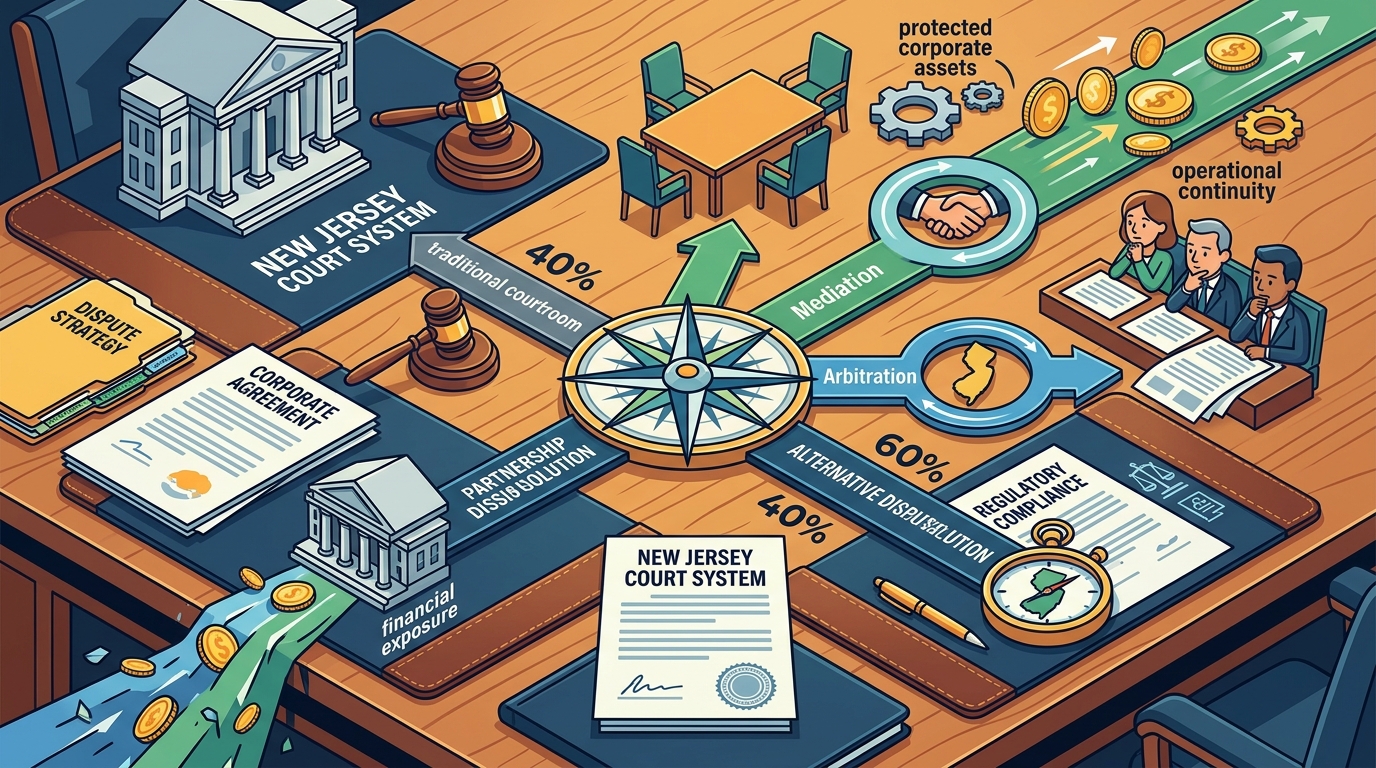
According to recent industry data, over sixty percent of commercial conflicts in the Garden State bypass traditional courtroom trials. This shift reflects a broader preference for streamlined resolution pathways that protect corporate assets and operational continuity. Businesses facing contractual breaches, partnership dissolutions, or regulatory compliance issues now face critical strategic decisions early in the dispute lifecycle. Selecting the appropriate mechanism directly impacts financial exposure and executive time allocation.
Understanding Corporate Dispute Resolution in New Jersey
Corporate disputes in New Jersey require precise strategic planning before any formal action is initiated. Alternative Dispute Resolution is a structured process that allows parties to settle conflicts outside formal court proceedings. Corporate litigation is the formal judicial process where disputes are adjudicated by a judge or jury under state statutes. Commercial arbitration is a binding adjudication method where a neutral third party reviews evidence and issues a final, enforceable decision. Each pathway carries distinct procedural requirements, evidentiary standards, and financial implications. Companies must evaluate their specific operational goals, confidentiality needs, and long-term commercial relationships before committing to a resolution strategy.
Evaluating Traditional Courtroom Litigation
Traditional litigation remains the most formal mechanism for resolving complex commercial disagreements. This process operates under strict procedural rules established by the New Jersey Court Rules. Parties exchange extensive discovery documents, depose key witnesses, and present arguments before a presiding judge. The primary advantage involves comprehensive discovery capabilities and the ability to appeal unfavorable rulings. However, courtroom proceedings typically require substantial financial investment and extended timelines. Public records remain accessible to competitors, media outlets, and potential investors. Companies prioritizing complete transparency and legal precedent often select this route. Firms like LoFaro Carver LLC provide dedicated commercial litigation support for high-stakes corporate conflicts.
Leveraging Mediation for Collaborative Settlements
Mediation serves as a highly effective mechanism for preserving ongoing business relationships while resolving underlying conflicts. A neutral facilitator guides structured negotiations without possessing decision-making authority. Both parties retain complete control over the final settlement terms and implementation schedule. This approach typically reduces legal expenditures by forty percent compared to full courtroom trials. Confidentiality remains strictly enforced, preventing sensitive corporate data from entering public records. Organizations seeking rapid resolutions and operational continuity frequently prioritize this method. Experienced mediators like those featured at LoFaro Carver LLC specialize in facilitating complex commercial negotiations across multiple industries.
Implementing Binding Arbitration Procedures
Binding arbitration provides a streamlined alternative to traditional court proceedings while maintaining enforceable legal outcomes. Parties select a qualified arbitrator who reviews submitted evidence and issues a final decision. This process eliminates lengthy discovery phases and reduces overall case duration significantly. Arbitration awards carry the same legal weight as court judgments and remain enforceable across state jurisdictions. Companies often select this pathway when contracts contain mandatory arbitration clauses or when specialized industry expertise is required. The American Arbitration Association maintains comprehensive guidelines for commercial dispute management. Organizations seeking predictable timelines and specialized adjudicators frequently implement this framework.
Comparing Costs, Timelines, and Confidentiality
Selecting the optimal resolution mechanism requires careful analysis of financial exposure, scheduling constraints, and information security requirements. The following table outlines the primary distinctions between available commercial dispute pathways.
| Resolution Mechanism | Estimated Timeline | Confidentiality Level | Primary Advantage |
|---|---|---|---|
| Courtroom Litigation | 18 to 36 months | Public records accessible | Comprehensive discovery and appellate rights |
| Mediation | 2 to 6 months | Strictly confidential | Preserved business relationships and flexible outcomes |
| Binding Arbitration | 6 to 12 months | Private proceedings | Specialized adjudicators and enforceable final awards |
| Alternative Dispute Resolution | 3 to 9 months | Customizable privacy terms | Cost efficiency and procedural flexibility |
Key Takeaways for New Jersey Businesses
- Over sixty percent of commercial conflicts now utilize alternative resolution pathways instead of traditional trials.
- LoFaro Carver LLC attorneys collectively possess over 110 years of combined New Jersey court system experience.
- AV Preeminent Rating recipients demonstrate the highest level of professional excellence and ethical standards.
- Mediation typically reduces legal expenditures by approximately forty percent compared to full litigation.
- Binding arbitration awards carry identical legal enforceability as final court judgments.
- Confidentiality protections remain strictly enforced across all mediation and arbitration proceedings.
- Senior partners like Hon. Alexander H. Carver, III bring over 45 years of specialized commercial dispute experience.
Frequently Asked Questions
What is the primary difference between mediation and arbitration?
Mediation involves a neutral facilitator who guides negotiations without issuing binding decisions. Arbitration features a qualified adjudicator who reviews evidence and issues a final, legally enforceable ruling.
Can corporate disputes be resolved without entering public court records?
Yes, both mediation and arbitration maintain strict confidentiality protocols that prevent sensitive corporate data from entering public records.
How does New Jersey law treat mandatory arbitration clauses in commercial contracts?
New Jersey courts generally enforce mandatory arbitration clauses when clearly drafted and mutually agreed upon by both corporate entities.
What qualifications should a corporate dispute mediator possess?
Effective mediators typically possess extensive legal backgrounds, specialized industry knowledge, and proven negotiation track records.
Are arbitration awards appealable under New Jersey commercial statutes?
Arbitration awards face extremely limited appellate review options, which provides finality but requires careful initial case preparation.
How long does the typical corporate dispute resolution process take?
Mediation typically concludes within two to six months, while arbitration generally requires six to twelve months for final resolution.
What financial factors influence the choice between litigation and alternative pathways?
Alternative pathways typically reduce legal expenditures by forty percent while eliminating extensive discovery phase costs.
Secure Expert Legal Guidance Today
Resolving corporate disputes requires precise strategic planning, comprehensive risk assessment, and experienced legal representation. Our firm provides customized resolution strategies tailored to your specific commercial objectives and operational constraints. Schedule a confidential consultation with our senior partners to evaluate your current dispute landscape. Visit our contact page to request a comprehensive case evaluation. Protect your corporate assets and operational continuity by selecting the optimal resolution pathway today.