

Legal disputes in New Jersey are uniquely complex due to the state's dense regulatory environment and layered court structure. According to recent industry analyses, over 95 percent of civil cases settle before reaching a trial verdict, highlighting the critical importance of understanding Alternative Dispute Resolution (ADR) versus traditional litigation. For business owners and individuals in Bergen County and across the Garden State, selecting the wrong path can result in unnecessary costs, prolonged timelines, and strained relationships. This guide breaks down the strategic differences to help you make an informed decision. (About Us New Jersey)
Understanding Alternative Dispute Resolution
Alternative Dispute Resolution (ADR) is a collective term for methods of resolving disputes outside of the traditional court system. In New Jersey, ADR has become the preferred method for resolving complex legal conflicts, offering a path away from the unpredictable nature of jury trials. The primary forms of ADR include mediation, arbitration, and negotiation.
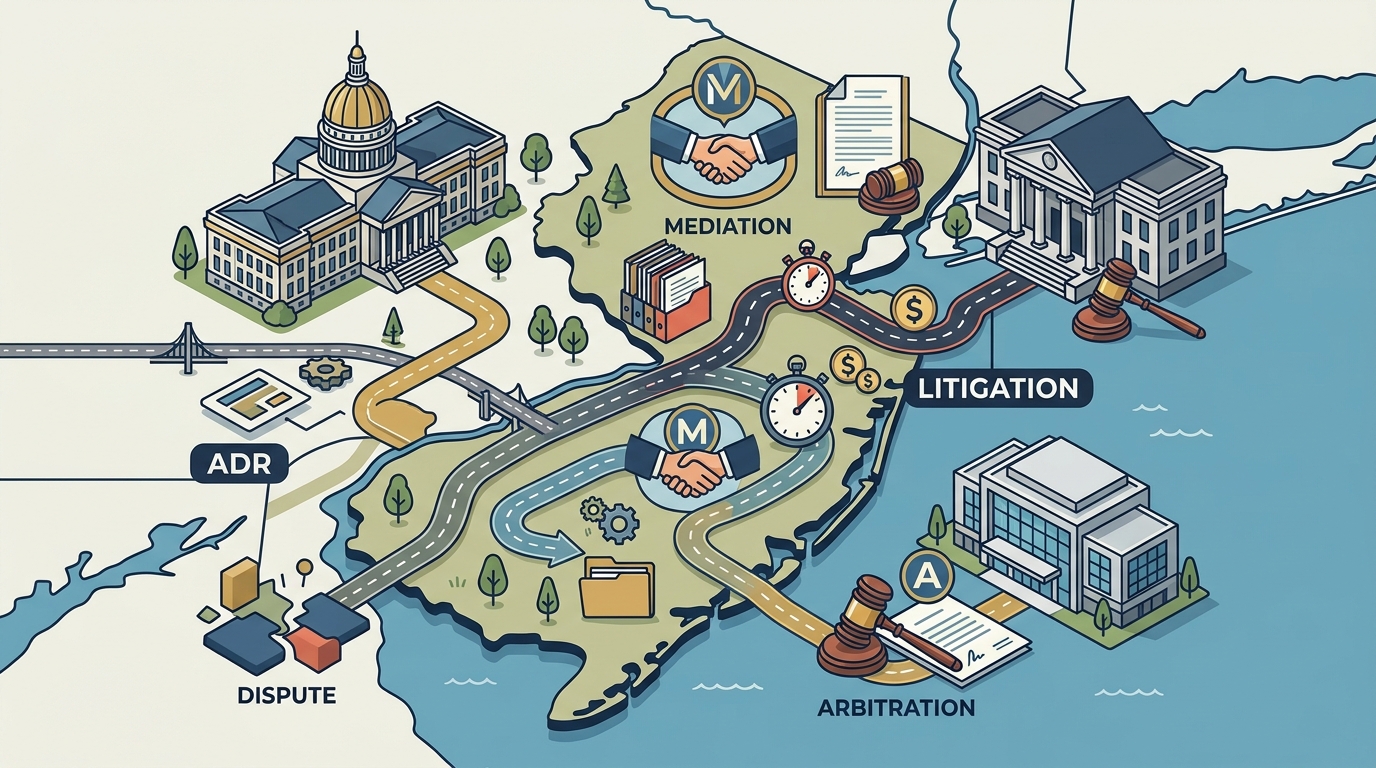
Mediation is a voluntary process where a neutral third party facilitates negotiation between disputing parties to help them reach a mutually acceptable agreement. Arbitration involves a neutral arbitrator who hears evidence and arguments from both sides and then makes a binding decision. Unlike a judge, an arbitrator is often an expert in the specific subject matter of the dispute, such as commercial real estate or corporate governance.
At LoFaro Carver LLC, we leverage the experience of former judges to guide clients through these processes. Hon. Alexander H. Carver, III, J.S.C. (Ret.), chairs our ADR department, bringing over 45 years of experience in both federal and state courts. His background includes significant land use cases and commercial litigation, providing a unique perspective on how to effectively navigate ADR in New Jersey.
The Litigation Landscape in New Jersey
Litigation is the formal process of resolving disputes through the court system. It involves filing complaints, conducting discovery, and presenting arguments before a judge or jury. While ADR offers flexibility, litigation provides structured procedural rules that can be essential when one party refuses to cooperate or when legal precedents need to be established.
New Jersey's court system is known for its complexity. Navigating the State’s civil, criminal courts, and municipal courts requires a deep understanding of local rules and judicial tendencies. According to data on legal efficiency, cases that proceed to full trial in New Jersey often take significantly longer to resolve than those settled through ADR. This delay can be detrimental to businesses seeking to maintain operational continuity.
Our team includes Hon. James J. Guida, J.S.C. (Ret.), who brings extensive experience from the bench. His insight into how judges evaluate evidence and arguments can be invaluable when deciding whether to pursue litigation. We combine courtroom insight with business acumen to help clients make informed decisions about their legal strategy.
Cost and Time Efficiency
One of the most significant factors in choosing between ADR and litigation is cost. Legal costs in New Jersey are often viewed as an opaque barrier to justice, yet understanding the underlying billing structures is the first step toward financial clarity.
ADR Costs
ADR is generally less expensive than litigation. The primary costs involve the fees for the neutral third party (mediator or arbitrator) and the preparation time for both parties. Because the process is streamlined and lacks the extensive discovery phases of litigation, legal fees are typically lower. For businesses, this means preserving capital for core operations rather than legal battles.
Litigation Costs
Litigation involves substantial costs, including court filing fees, expert witness fees, deposition costs, and extensive attorney hours. According to industry reports, the average cost of commercial litigation in the United States can exceed hundreds of thousands of dollars, depending on the complexity and duration of the case. In New Jersey, the layered court structure can further complicate and extend these costs.
| Factor | Alternative Dispute Resolution (ADR) | Litigation |
|---|---|---|
| Time to Resolution | Weeks to Months | Months to Years |
| Cost | Lower (Shared Neutral Fees) | Higher (Extensive Discovery & Trial) |
| Privacy | High (Confidential) | Low (Public Record) |
| Control | High (Parties Decide Outcome) | Low (Judge/Jury Decides) |
| Appealability | Limited | Full Right to Appeal |
Privacy and Confidentiality
Privacy is a critical consideration for businesses and high-net-worth individuals. ADR proceedings are private and confidential. The details of the dispute, the evidence presented, and the settlement terms are not part of the public record. This confidentiality protects trade secrets, reputational capital, and personal privacy.
In contrast, litigation is a public process. Court filings, depositions, and trial proceedings are accessible to the public. For a New Jersey business, this lack of privacy can be damaging. Competitors, investors, and the media can access these records, potentially harming the company's brand and market position. According to legal industry surveys, confidentiality is cited as a top reason for choosing ADR in commercial disputes.
Control Over the Outcome
In ADR, the parties retain control over the process and the outcome. In mediation, the parties work together to craft a solution that meets their specific needs. This flexibility allows for creative resolutions that a court cannot order, such as continued business partnerships, specific performance terms, or non-monetary apologies.
In litigation, the outcome is determined by a judge or jury based strictly on legal principles and evidence. The result is binary: one party wins, and the other loses. There is little room for compromise or creative problem-solving. Furthermore, the unpredictability of jury verdicts adds a significant risk factor. According to data on legal outcomes, jury verdicts can be inconsistent and often exceed initial settlement offers, leading to further appeals and costs.
When Litigation is Necessary
While ADR is often the preferred route, there are scenarios where litigation is necessary. If one party is acting in bad faith or refusing to participate in good faith negotiations, ADR may fail. In such cases, the formal discovery process of litigation can be used to compel disclosure of evidence.
Litigation is also appropriate when a legal precedent needs to be set or when injunctive relief is required to stop ongoing harm. For example, in intellectual property disputes or complex real estate boundary issues, a court order may be the only effective remedy. Our team at LoFaro Carver LLC evaluates each case to determine if litigation is the strategic choice or if ADR should be pursued first.
Key Takeaways
- Experience Matters: Our team has over 110 years of combined experience in New Jersey’s civil, criminal, municipal, appellate, and federal courts.
- Former Judges: We include two former judges, Hon. Alexander H. Carver, III, J.S.C. (Ret.) and Hon. James J. Guida, J.S.C. (Ret.), providing unique insight into judicial decision-making.
- ADR Efficiency: ADR typically resolves disputes in weeks or months, compared to years for litigation.
- Cost Savings: ADR reduces legal fees by minimizing discovery and court appearances.
- Confidentiality: ADR keeps dispute details private, protecting business reputation and personal privacy.
- Flexibility: ADR allows for creative, mutually beneficial solutions that courts cannot order.
- Recognition: Our attorneys are recognized in New Jersey Super Lawyers, Best Lawyers in America, and hold the AV Preeminent Rating.
Frequently Asked Questions
What is the main difference between mediation and arbitration?
Mediation is a facilitated negotiation where the mediator helps parties reach a voluntary agreement. Arbitration involves a neutral arbitrator who acts like a judge, hearing evidence and making a binding decision.
Is ADR always cheaper than litigation?
Generally, yes. ADR avoids the high costs of extensive discovery, court fees, and prolonged trial preparation. However, the cost depends on the complexity of the dispute and the fees of the neutral third party.
Can I force the other party to use ADR?
Not always. Mediation is voluntary. However, many contracts include arbitration clauses that mandate ADR. In some New Jersey courts, judges may order mediation before allowing a case to proceed to trial.
What happens if ADR fails?
If ADR fails, the parties can proceed to litigation. The negotiations in ADR are typically confidential and cannot be used against you in court, preserving your legal options.
Why choose a former judge for ADR?
Former judges bring a deep understanding of how cases are decided in court. This insight helps them guide parties toward realistic settlements and evaluate the strengths and weaknesses of each side's position effectively.
How long does the ADR process take?
Mediation can often be scheduled within weeks and resolved in a single day or a few sessions. Arbitration may take longer, depending on the complexity, but is still typically faster than litigation.
Does LoFaro Carver LLC handle both ADR and litigation?
Yes. We provide strategic counsel for both paths, ensuring you have the right representation whether you settle in the conference room or fight in the courtroom.
Contact LoFaro Carver LLC
Choosing the right legal path requires expert guidance. Whether you are planning a transaction, responding to a dispute, facing a criminal charge, or making a significant real-estate decision, our lawyers work to identify issues early and provide a practical path forward with candor and care. Contact us today to schedule a consultation and discuss your objectives.
Click here to contact LoFaro Carver LLC and take the first step toward resolving your legal matter efficiently.