

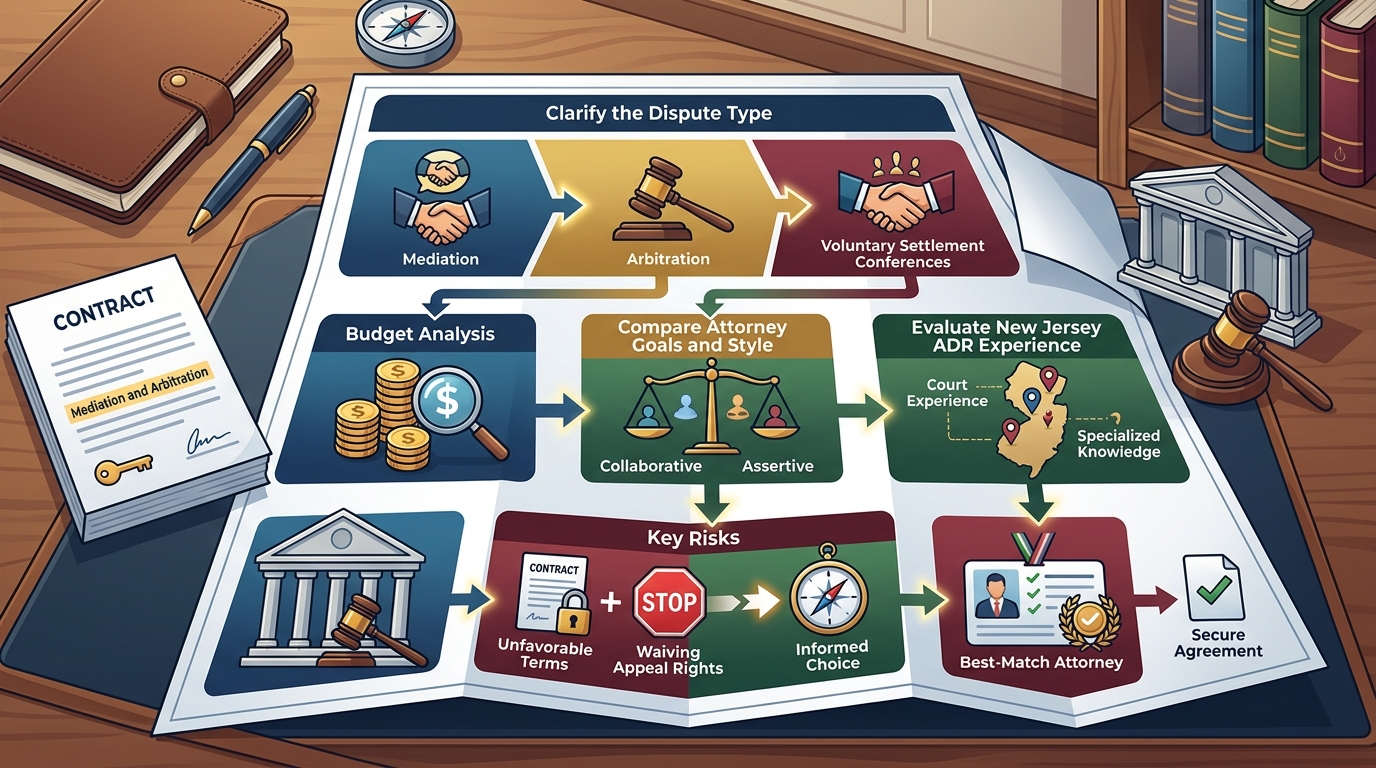
Mediation clauses in contracts, court-ordered arbitration panels, and voluntary settlement conferences are everyday realities in New Jersey litigation. Picking the wrong attorney for these proceedings can leave you locked into unfavorable terms or, worse, waiving appeal rights you did not fully understand. This step-by-step tutorial shows you exactly how to evaluate, compare, and hire an ADR lawyer who matches your dispute type, budget, and goals.
Step 0 — Identify Which ADR Process Applies to You
Before contacting a single attorney, clarify the type of ADR process you face. The approach your lawyer takes in mediation is fundamentally different from the approach required in binding arbitration.
Mediation
In mediation, a neutral facilitator helps you negotiate but does not decide the outcome. You retain full control. If no agreement is reached, you can still go to court. This is especially common in New Jersey family law and civil matters. The New Jersey Division of Consumer Affairs uses mediation and arbitration as its two primary ADR forms, and the state Supreme Court even requires court-ordered mediation in certain proceedings before a judge will hear the case.
Arbitration
Arbitration is more adjudicative. A single arbitrator or a three-member panel hears evidence and issues a binding award that is enforceable like a court judgment. Appeal rights are extremely limited. In New Jersey, the Alternative Procedure for Dispute Resolution Act (N.J.S.A. 2A:23A-1 to 30) governs private arbitration and imposes a distinctive requirement: arbitrators must resolve disputes according to substantive law, a standard drawn from New Jersey case law holding arbitrators to the same accuracy benchmark as judges.
Other ADR Methods
Negotiation, early neutral evaluation, and the appointment of a Special Master also fall under the ADR umbrella. A Special Master, for instance, can be appointed by the court to manage discovery disputes and keep a complex case on track. Knowing which process you need narrows your attorney search dramatically.
Step 1 — Map the New Jersey Rules That Govern Your Case
New Jersey has a layered regulatory framework for ADR. An attorney who does not know these rules inside-out is the wrong attorney for your case.
Key Statutes and Court Rules
- N.J.S.A. 2A:23A-1 to 30 — The Alternative Procedure for Dispute Resolution Act, which establishes rules for private judging and arbitration.
- N.J.S.A. 2A:23C-1 to 13 — New Jersey's adoption of the Uniform Mediation Act, covering privilege and confidentiality protections for information exchanged during mediation as well as mediator conflict-of-interest rules.
- Court Rule 1:40 — Governs Complementary Dispute Resolution Programs in New Jersey state courts, with separate referral procedures for mediation of civil, probate, general equity, custody, parenting time, and municipal court matters.
- Court Rule 4:21A — Mandates arbitration of certain civil actions, including all personal injury and auto negligence cases, and permits voluntary arbitration by stipulation for other case types.
Your prospective lawyer should be able to cite these provisions without looking them up. If they cannot, move on.
Federal Court ADR in New Jersey
If your dispute is in the U.S. District Court for the District of New Jersey, mediation is governed by Local Civil Rule 301.1. Any district judge or magistrate judge may refer a civil action to mediation, sometimes without the consent of the parties. However, the court encourages voluntary consent, and parties may choose a mediator from the court's certified list or retain a private mediator.
Step 2 — Define Your Priorities Before You Interview Lawyers
Different disputes call for different attorney strengths. Rank the following priorities before you start making calls:
| Priority | Why It Matters | Best Fit |
|---|---|---|
| Speed of resolution | You need the matter closed within weeks, not months | Lawyer with high mediation settlement rate |
| Binding outcome | You need finality and cannot risk an inconclusive session | Experienced arbitration advocate |
| Relationship preservation | You will continue doing business or co-parenting with the other side | Attorney skilled in interest-based negotiation |
| Cost control | You have a fixed budget and cannot afford extended hearings | Flat-fee or capped-fee ADR counsel |
| Technical complexity | The dispute involves specialized industry knowledge | Lawyer with subject-matter expertise in addition to ADR training |
Writing these priorities down creates a scorecard you can use objectively when comparing candidates.
Step 3 — Evaluate ADR-Specific Credentials and Track Records
General litigation experience does not automatically translate to ADR effectiveness. The skills required to advocate for a client in mediation or arbitration differ from those used at trial.
Certifications and Training to Look For
- NJ Certified Professional Mediator — Approved by New Jersey courts to serve in court-connected mediation programs.
- AAA or JAMS Panel Membership — Indicates the attorney has been vetted by a major ADR provider and is familiar with institutional arbitration rules.
- Advanced Mediation or Arbitration CLE — Continuing legal education focused on ADR practice, not just general trial skills.
Track Record Indicators
Ask for specific metrics: How many mediations has the lawyer participated in during the past two years? What percentage reached settlement? How many arbitration hearings has the lawyer handled as an advocate (not as the neutral)? Concrete numbers distinguish experienced ADR counsel from attorneys who merely list ADR on their website.
Step 4 — Ask the Right Questions During a Consultation
A productive initial consultation should go beyond "tell me about my case." Here are targeted questions for evaluating an ADR attorney in New Jersey:
- "Which ADR method do you recommend for my dispute, and why?" — A competent attorney will explain the trade-offs. Mediation suits situations where the parties have a workable relationship and want creative solutions. Arbitration is better when you need a binding, enforceable decision and technical expertise from the neutral.
- "Have you handled cases under Court Rule 1:40 or 4:21A?" — This tests their familiarity with mandatory arbitration and court-annexed mediation procedures specific to New Jersey.
- "Who are the mediators or arbitrators you typically work with in this county?" — ADR outcomes are heavily influenced by the neutral. An attorney who knows the local panel members can advise you on whom to select or reject.
- "What is your approach if mediation fails?" — You need to know whether the attorney has a litigation contingency plan or whether they only handle the ADR phase.
- "Can you walk me through a recent matter similar to mine?" — Listen for specifics about process, timeline, and result. Vague responses are a warning sign.
Step 5 — Compare Fee Structures and Engagement Terms
ADR attorney fees in New Jersey vary based on complexity, ADR method, and lawyer experience. Common structures include:
- Hourly billing — Standard for arbitration advocacy, which may involve discovery, brief writing, and multi-day hearings.
- Flat fee for mediation representation — Appropriate for single-session mediations with well-defined issues.
- Hybrid or capped arrangements — A flat fee for preparation plus hourly billing for session time, with a cap.
In New Jersey's court-connected mediation program, mediators serve for free for the first two hours. However, your own attorney's time is billed separately. Clarify whether the retainer covers only the ADR session or also includes pre-session strategy, document review, and post-session follow-up.
Red Flags in Engagement Letters
- No defined scope of work — leads to billing disputes.
- Automatic escalation to litigation without a separate engagement — can dramatically increase costs.
- Vague withdrawal clauses — you need clear terms on how either party can end the relationship.
Step 6 — Confirm Conflict-of-Interest and Ethical Safeguards
ADR practice in New Jersey is governed by specific ethics standards. The New Jersey Standards of Conduct for Mediators in Court-Connected Programs and the Standards of Conduct for Arbitrators in the Court-Annexed Arbitration Program set the rules for neutrals. Your attorney should understand these standards because they affect how information is shared and protected.
Confidentiality Protections
Under New Jersey's Uniform Mediation Act (N.J.S.A. 2A:23C), information exchanged during mediation is privileged. Additionally, under state administrative code, parties may not use information gained solely from mediation in any subsequent proceeding. Your attorney must structure their strategy around these protections to avoid inadvertent disclosure that could harm your position later.
Conflicts of Interest
Ask whether the attorney has represented the opposing party, the mediator, or the arbitrator in other matters. In the close-knit New Jersey ADR community, these overlaps are common. Transparency here protects you from bias and preserves the integrity of the process.
Key Takeaways
- Identify whether your dispute calls for mediation, arbitration, or another ADR method before you contact any lawyer.
- New Jersey has detailed ADR statutes and court rules — your attorney must be fluent in them, including Court Rule 1:40, Court Rule 4:21A, and the Uniform Mediation Act.
- ADR advocacy is a distinct skill set. Evaluate credentials, panel memberships, and settlement track records specifically.
- Prepare a ranked list of your priorities (speed, cost, binding outcome, relationship preservation) and use it as a scorecard during consultations.
- Scrutinize fee structures and engagement letters for hidden escalation clauses or vague scope definitions.
- Verify conflict-of-interest disclosures, especially given the small and interconnected nature of New Jersey's ADR practitioner community.
Frequently Asked Questions
Is mediation mandatory in New Jersey?
In many cases, yes. Under Court Rule 1:40, New Jersey courts refer civil, probate, general equity, and custody matters to mediation. Under Court Rule 4:21A, all personal injury and automobile negligence actions are referred to mandatory arbitration. In the federal District of New Jersey, judges can refer cases to mediation even without party consent under Local Civil Rule 301.1.
What is the difference between a mediator and my ADR attorney?
A mediator is the neutral facilitator who helps both sides negotiate. Your ADR attorney is your advocate — they prepare your case, advise you on strategy, and protect your legal interests during the session. Mediators and arbitrators do not provide legal advice and do not act as a lawyer for any party, which is precisely why having your own counsel is critical.
How much does an ADR attorney cost in New Jersey?
Costs vary widely. Mediation representation for a straightforward matter might be handled on a flat-fee basis of a few thousand dollars. Arbitration advocacy involving discovery and multi-day hearings can run significantly higher on an hourly basis. In court-connected mediation, the mediator's first two hours are free, but your attorney bills separately for their time.
Can I appeal an arbitration award in New Jersey?
Appeal rights are very limited. Under the NJ Alternative Procedure for Dispute Resolution Act, arbitrators must apply substantive law, which provides some basis for judicial review. However, standard commercial arbitration awards are rarely overturned by courts if the parties formed a valid agreement to arbitrate.
Should I choose a lawyer who is also a certified mediator?
An attorney who has trained as a mediator often brings valuable perspective — they understand the neutral's thought process and can position your case more effectively. However, the attorney must be clear about whether they are representing you as an advocate or serving as a neutral. These are distinct roles with different ethical obligations.
How do I find ADR attorneys in New Jersey?
Start with the New Jersey State Bar Association's lawyer referral service. You can also review the roster of approved mediators and arbitrators maintained by the American Arbitration Association (AAA) and JAMS, two of the largest ADR service providers operating in New Jersey. Court websites for the District of New Jersey maintain certified mediator lists as well.