

Commercial disputes in New Jersey are uniquely complex due to the state's dense regulatory environment and layered court structure. According to recent legal industry reports, over 95% of civil cases in New Jersey are resolved before reaching a final trial verdict. This statistic highlights a critical reality for business owners: the path you choose to resolve a conflict dictates not only the financial outcome but also the preservation of professional relationships and public reputation. Understanding the nuances between settlement, mediation, arbitration, and litigation is the first step toward securing a favorable resolution. (About Us New Jersey)
Understanding the Four Primary Options
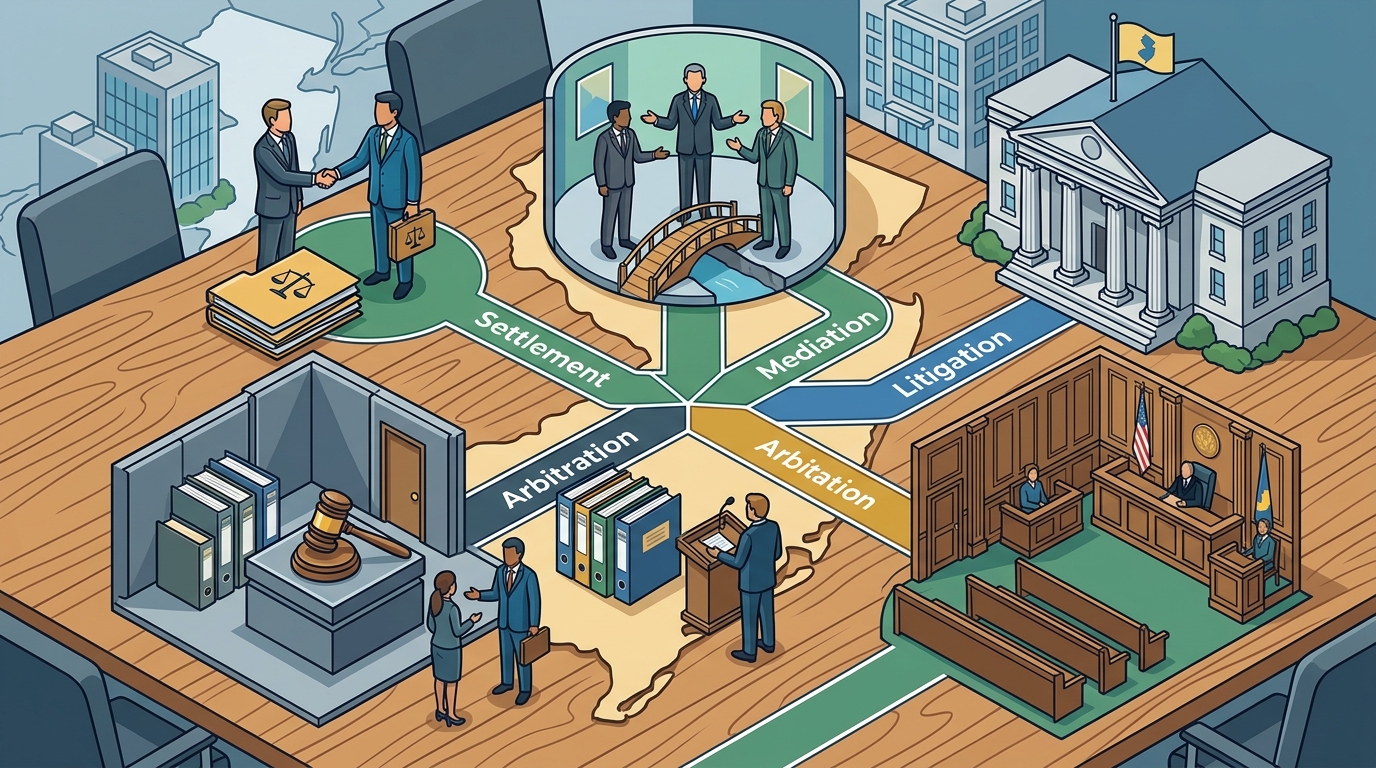
When a business dispute arises, the initial reaction is often to immediately file a lawsuit. However, New Jersey law offers a spectrum of alternatives that may better serve your commercial interests. Litigation is the formal process of resolving disputes through the court system, involving judges, juries, and strict procedural rules. Settlement is a voluntary agreement between parties to resolve a dispute without a trial, often reached through negotiation. Mediation is a form of alternative dispute resolution where a neutral third party facilitates negotiation but does not impose a decision. Arbitration is a formal process where a neutral arbitrator hears evidence and renders a binding decision, similar to a private trial. (LoFARO CARVER LLC Business)
Each method carries distinct implications for cost, time, privacy, and control. The choice depends heavily on the nature of the dispute, the relationship between the parties, and the specific goals of your business. Navigating these options requires a strategic legal partner who understands both the courtroom and the negotiation table.
Direct Settlement: Speed and Control
Direct settlement is often the most efficient way to resolve commercial conflicts. It allows parties to retain complete control over the outcome, rather than leaving the decision in the hands of a judge or jury. In New Jersey, many business disputes are resolved through direct negotiation or through the guidance of counsel before formal proceedings begin.
The primary advantage of settlement is predictability. You know the exact cost and timeline upfront, avoiding the unpredictable expenses of prolonged litigation. Furthermore, settlements are private. Unlike court records, which are generally public, settlement agreements can remain confidential, protecting your business's trade secrets and reputation. For companies seeking to maintain a business relationship with the opposing party, settlement offers the least adversarial path forward.
However, settlement requires compromise. Neither side gets everything they want, and the process can stall if parties are unwilling to negotiate in good faith. This is where experienced counsel becomes invaluable, ensuring that any agreement is legally sound and financially viable.
Mediation: The Collaborative Approach
Mediation has gained significant traction in New Jersey business law as a preferred method for resolving complex commercial disputes. It is a voluntary process where a neutral mediator helps the parties communicate and negotiate a mutually acceptable solution. The mediator does not decide the case but rather facilitates dialogue to uncover underlying interests.
One of the most compelling benefits of mediation is its flexibility. Parties can craft creative solutions that a court could not order, such as future business partnerships, specific performance clauses, or non-monetary apologies. This flexibility is particularly useful in disputes involving long-term contracts or joint ventures where the business relationship is valuable.
Mediation is also generally faster and less expensive than litigation. According to industry data, mediated cases often resolve in a fraction of the time of traditional court proceedings. Additionally, the success rate for mediation in New Jersey is high, with many commercial cases settling during the process. For businesses that value privacy and relationship preservation, mediation is often the optimal first step.
Arbitration vs. Litigation: Key Differences
When mediation fails or is not an option, the choice often lies between arbitration and litigation. Both are adversarial processes, but they operate in fundamentally different environments. Arbitration is a private proceeding where an arbitrator, chosen by the parties or a designated institution, hears the case and issues a binding award. Litigation occurs in the public court system, presided over by a judge and potentially a jury.
Arbitration is often chosen for its speed and expertise. Arbitrators are frequently subject matter experts in fields like construction, finance, or intellectual property, allowing for a more nuanced understanding of complex commercial issues. The process is also more streamlined, with fewer procedural delays than the congested New Jersey court dockets. Privacy is another major factor; arbitration proceedings are confidential, keeping sensitive business information out of the public record.
Litigation, on the other hand, offers procedural safeguards that arbitration lacks. Parties have the right to appeal a court decision, whereas arbitration awards are extremely difficult to overturn. Litigation also allows for broader discovery, enabling parties to obtain evidence from the opposing side more comprehensively. For cases involving significant legal principles or where public precedent is important, litigation may be the necessary choice.
Comparative Analysis of Dispute Resolution
Choosing the right path requires a clear understanding of the trade-offs involved. The table below summarizes the key differences between the four primary dispute resolution mechanisms available to New Jersey businesses.
| Method | Control Over Outcome | Cost | Timeframe | Privacy | Appeal Rights |
|---|---|---|---|---|---|
| Settlement | High (Mutual Agreement) | Low to Moderate | Fastest | Confidential | N/A |
| Mediation | High (Facilitated) | Moderate | Short | Confidential | N/A |
| Arbitration | Low (Arbitrator Decides) | Moderate to High | Moderate | Confidential | Very Limited |
| Litigation | Low (Judge/Jury Decides) | High | Long | Public Record | Full Rights |
This comparison illustrates that there is no single "best" option. The right choice depends on your specific priorities. If speed and privacy are paramount, settlement or mediation may be ideal. If you need a binding precedent or broad discovery, litigation might be necessary. If you prefer a specialized decision-maker, arbitration offers a compelling middle ground.
Key Takeaways
- Experience Matters: LoFaro Carver LLC brings over 110 years of combined experience in New Jersey’s civil, criminal, municipal, appellate, and federal courts to every dispute resolution strategy.
- Judicial Insight: Our team includes two former judges, Hon. Alexander H. Carver, III, J.S.C. (Ret.) and Hon. James J. Guida, J.S.C. (Ret.), providing unique insight into how cases are viewed from the bench.
- ADR Expertise: We specialize in Alternative Dispute Resolution, offering strategic counsel for mediation and arbitration to avoid the costs of trial.
- Commercial Focus: Our business and corporate law practice is tailored to the specific needs of entrepreneurs, startups, and established corporations in New Jersey.
- Cost-Effective Strategy: We prioritize cost-effective solutions, ensuring that legal spending aligns with the potential value of the dispute.
- Confidentiality: We understand the importance of privacy in business disputes and work to keep sensitive information out of the public record whenever possible.
- Comprehensive Services: From contract drafting to complex litigation, we provide full-service legal support to protect your business interests at every stage.
Frequently Asked Questions
What is the difference between mediation and arbitration in New Jersey?
Mediation is a non-binding process where a neutral third party facilitates negotiation to help parties reach a voluntary agreement. Arbitration is a binding process where a neutral arbitrator hears evidence and makes a final decision, similar to a private judge.
Can I force the other party to mediate my business dispute?
Generally, no. Mediation is voluntary. However, many New Jersey courts may require parties to attempt mediation before proceeding to trial. Additionally, many commercial contracts include mandatory mediation clauses that require parties to attempt mediation before filing a lawsuit.
Is arbitration cheaper than litigation in New Jersey?
Arbitration can be less expensive than litigation due to its streamlined process and shorter timeframe. However, the costs of arbitrator fees and administrative expenses can sometimes make it comparable to or even more expensive than litigation, depending on the complexity of the case.
What are the appeal rights in arbitration?
Award rights in arbitration are extremely limited. Under the New Jersey Arbitration Act, an arbitration award can only be vacated in very specific circumstances, such as fraud, corruption, or arbitrator misconduct. You generally cannot appeal an arbitration award simply because you disagree with the outcome.
How does LoFaro Carver LLC determine the best dispute resolution method?
We evaluate the specific facts of your case, the terms of any existing contracts, the relationship between the parties, and your business goals. Our team leverages our combined experience to recommend the most strategic and cost-effective path forward.
What is the typical cost of hiring a business dispute attorney in New Jersey?
Legal costs vary widely based on the complexity of the dispute and the chosen resolution method. Some attorneys offer flat fees for specific services, while others bill hourly. We provide transparent pricing models during our initial consultation to help you understand the financial commitment.
Can I settle a case after filing a lawsuit?
Yes, cases can be settled at any stage of litigation, even after a trial has begun. In fact, many cases settle during the discovery phase or just before trial. Our attorneys are skilled negotiators who can often secure favorable settlements even after litigation has commenced.
Contact LoFaro Carver LLC
Choosing the right dispute resolution strategy is a critical decision that impacts your business's future. Do not navigate this complex landscape alone. Our team of seasoned practitioners is ready to provide the strategic counsel you need. Whether you are facing a commercial dispute, a corporate governance issue, or a complex transaction, we are here to help.
Contact LoFaro Carver LLC today to schedule a consultation. We offer practical, strategic counsel for transactions, disputes, and criminal matters that call for clear judgment and responsive representation. Visit our Business & Corporate Law page to learn more about our services. For insights on corporate dispute resolution, read our Corporate Dispute Resolution in NJ: Step-by-Step Guide. Explore our Alternative Dispute Resolution services to understand how mediation and arbitration can benefit your business.