

When a business dispute escalates—whether it involves a breached contract, a partnership falling apart, or a competitor engaging in unfair practices—the attorney you choose can determine the outcome. New Jersey's commercial litigation landscape is uniquely complex, with specialized court programs and state-specific statutes that demand genuine expertise. This guide walks you through a practical, step-by-step process for identifying and hiring the right commercial litigation attorney in the Garden State.
What Qualifies as Commercial Litigation in New Jersey?
Before you start your search, it helps to know exactly what falls under this umbrella. Commercial litigation refers to disputes between businesses, or between businesses and their customers, vendors, or suppliers. Common categories include:
- Breach of contract — Disputes over what a contract means or the fact that one party failed to live up to the terms of the agreement.
- Shareholder and partnership disputes — Including corporate buyouts, oppression claims, and business dissolution.
- Business torts — Such as tortious interference with prospective economic advantage, unfair competition, and theft of trade secrets.
- Consumer fraud claims — Under the New Jersey Consumer Fraud Act, businesses found in violation may be required to pay treble damages plus attorneys' fees.
- Fraud and misrepresentation — Both common law fraud and statutory fraud under NJ law.
- Real estate and construction disputes — Contract performance issues, property disputes, and construction defect claims.
- Creditor/debtor disputes — Collections, loan restructuring, and asset recovery actions.
The types of cases that land in New Jersey courts range from closely held corporate shareholder claims and business dissolutions to multi-state litigation between publicly held conglomerates.
Step 1: Understand How New Jersey Courts Handle Commercial Cases
New Jersey has a dedicated Complex Business Litigation Program (CBLP) that helps resolve complex business, commercial, and construction cases in an expedited manner. A case is automatically assigned to the CBLP if the amount in controversy is at least $200,000 and the litigants self-designate the case as complex commercial or complex construction. Even if the claim is under $200,000, litigants can file a motion requesting inclusion if the case involves complex business-related issues.
Knowing about CBLP matters because you want an attorney who has direct experience practicing within this program. Lawyers who regularly appear before CBLP judges understand the expedited timelines, templated forms, and judicial expectations that characterize these proceedings. Ask prospective attorneys specifically whether they have handled CBLP cases.
Step 2: Define the Scope and Stakes of Your Dispute
Before reaching out to law firms, take time to organize the key facts of your situation:
- Identify the dispute type — Is this a breach of contract, a partnership breakdown, an intellectual property issue, or something else?
- Estimate the financial exposure — Commercial disputes often involve significant financial exposure, operational impact, and reputational considerations. An accurate estimate helps you find a firm with appropriate resources.
- Gather relevant documents — Contracts, correspondence, financial records, and communications that relate to the dispute.
- Determine urgency — Do you need emergency injunctive relief, or is this a matter that can proceed on a normal timeline?
- Consider jurisdiction — Will the case be heard in New Jersey state court, federal court (District of New Jersey), or potentially involve arbitration?
This preparation will make initial consultations far more productive and help you evaluate whether a given attorney truly understands your situation.
Step 3: Use Reputable Directories and Peer-Review Platforms
Peer-reviewed legal directories are among the most reliable starting points. Best Lawyers, for example, provides a trusted directory of top commercial litigation legal professionals in New Jersey. Their recognition is based entirely on peer review, using a methodology designed to capture the consensus opinion of leading lawyers about the professional abilities of their colleagues within the same geographical area and legal practice area.
Other valuable resources include:
- Super Lawyers — Identifies top-rated attorneys across practice areas using peer nominations, independent research, and peer evaluations.
- Chambers USA — Ranks law firms and individual lawyers by practice area based on client feedback and market research.
- Martindale-Hubbell — Provides peer-review ratings and client reviews.
- New Jersey State Bar Association Lawyer Referral Service — Connects the public with qualified attorneys in specific practice areas.
Cross-reference multiple directories rather than relying on a single source. An attorney who appears consistently across several platforms demonstrates broad professional recognition.
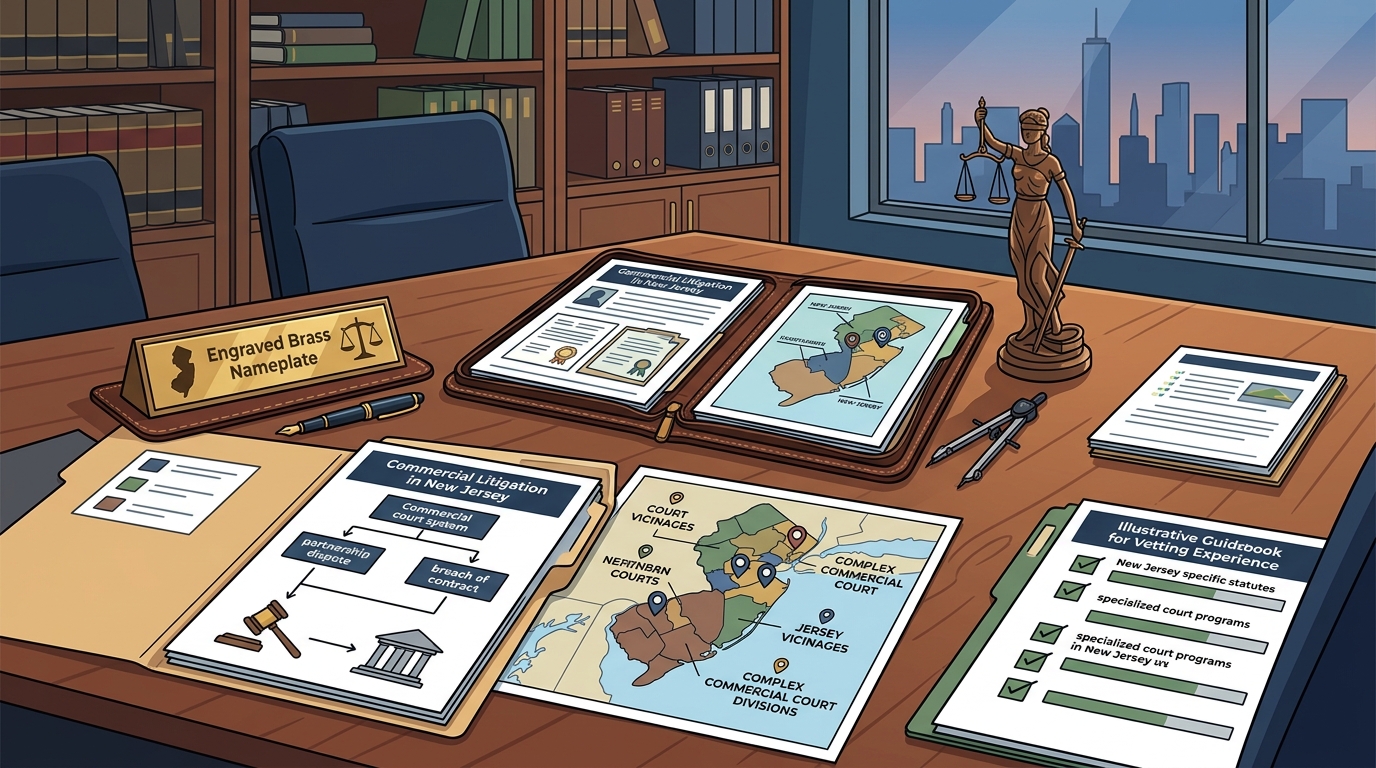
Step 4: Look for Certified Civil Trial Attorneys
New Jersey offers a distinctive credential that most states do not: the Certified Civil Trial Attorney designation granted by the Supreme Court of New Jersey. This certification is granted to only about 4 percent of all attorneys in New Jersey, making it a powerful indicator of courtroom competence.
Not every commercial litigation matter goes to trial, but hiring a certified trial attorney signals that your lawyer can credibly threaten trial if settlement negotiations fail. Opposing counsel and their clients are more likely to negotiate in good faith when they know the other side has a battle-tested trial lawyer.
Step 5: Evaluate Firm Size and Resources Against Your Needs
New Jersey commercial litigation firms range from solo practitioners to major regional and national firms. The right choice depends on your case complexity:
| Firm Type | Best For | Typical Fee Structure |
|---|---|---|
| Solo / Small Firm (1–5 attorneys) | Straightforward contract disputes, small-business partnership issues, cases under $500K | Hourly; sometimes flat fee for discrete tasks |
| Mid-Size Firm (6–50 attorneys) | Moderately complex disputes, multi-party cases, CBLP matters | Hourly with potential blended rates |
| Large Regional / National Firm (50+ attorneys) | High-stakes bet-the-company litigation, multi-state disputes, class actions, antitrust | Premium hourly rates; alternative fee arrangements available |
Most commercial litigation matters are handled on an hourly basis, while a small handful of others may be subject to a flat fee. During your consultation, discuss fees openly and ask whether the firm offers alternative billing arrangements such as phased billing, fee caps, or success-based components.
Step 6: Conduct Targeted Consultations
Narrow your list to three to five firms and schedule initial consultations. Many New Jersey commercial litigation firms offer free or low-cost initial consultations. Use these meetings to assess:
- Subject-matter experience — Has the attorney handled cases similar to yours in both type and scale?
- Court familiarity — Does the attorney regularly practice in the specific court (e.g., Bergen County Superior Court, Essex County Chancery Division, District of New Jersey) where your case is likely to be heard?
- Strategic approach — Does the attorney default to aggressive litigation, or do they thoughtfully evaluate whether negotiation, mediation, or arbitration might be more efficient? Since commercial disputes can sometimes be resolved through negotiation, saving the client the cost and aggravation of protracted litigation is a worthy goal.
- Communication style — Some clients want to be hands-on and intimately involved in trying to resolve matters, while others want to delegate disputes to trusted attorneys. Make sure the firm's style matches your preference.
- Team composition — Who will actually handle your case day-to-day? Will it be the partner you met, or will the work be delegated to associates?
Step 7: Verify Track Record and References
Ask for case outcomes relevant to your dispute type. Experienced commercial litigators should be able to describe representative results—for instance, multi-million-dollar judgments in fraud cases, successful defense of breach-of-contract claims, or favorable arbitration outcomes.
Beyond results, look for:
- Published opinions — New Jersey courts publish opinions from the Complex Business Litigation Program. If your prospective attorney has cases cited in published opinions, that demonstrates a high level of practice.
- Referral reputation — Top firms often receive a significant share of their clients through referrals from other lawyers. A strong referral network suggests the attorney is well-respected by peers.
- Industry knowledge — If your dispute involves a specific industry (healthcare, technology, manufacturing, real estate), look for an attorney who understands the regulatory and operational nuances of that sector.
Step 8: Understand Key New Jersey Statutes That May Affect Your Case
An experienced New Jersey commercial litigation attorney should be conversant with these critical laws:
- New Jersey Consumer Fraud Act (N.J.S.A. 56:8-1 et seq.) — Makes it illegal for anybody to use a deception, fraud, false promise, misrepresentation, or unconscionable commercial practice. Violations can result in treble damages plus attorneys' fees.
- Uniform Commercial Code (N.J.S.A. 12A:1-101 et seq.) — Governs sales of goods, secured transactions, and commercial paper.
- New Jersey Court Rule 4:21A — Requires certain cases to participate in mandatory non-binding arbitration, an important procedural step in many commercial disputes.
- Oppressed Shareholders' Rights (N.J.S.A. 14A:12-7) — Protects minority shareholders in closely held corporations.
- Trade Secrets Act (N.J.S.A. 56:15-1 et seq.) — Provides remedies for misappropriation of trade secrets.
During your consultation, test the attorney's familiarity with these statutes by asking how they might apply to your situation. A knowledgeable attorney will provide specific, practical answers rather than generic overviews.
Step 9: Assess Pre-Litigation and Alternative Dispute Resolution Capabilities
Not every commercial dispute requires a courtroom battle. Top commercial litigation attorneys also regularly advise clients on dispute avoidance, contract risk management, and pre-litigation positioning. Look for attorneys who can:
- Send effective demand letters that motivate settlement
- Negotiate forbearance agreements and restructuring terms
- Represent you in mediation or private arbitration
- Pursue emergency relief (temporary restraining orders, preliminary injunctions) when assets are at risk
The best commercial litigators understand that saving you money and minimizing business disruption is often more valuable than winning a Pyrrhic courtroom victory.
Key Takeaways
- Commercial litigation in New Jersey covers a wide range of disputes from breach of contract to shareholder oppression and business torts.
- New Jersey's Complex Business Litigation Program expedites cases with amounts in controversy of $200,000 or more—find an attorney experienced in this program.
- The Certified Civil Trial Attorney designation from the NJ Supreme Court is held by only about 4% of New Jersey lawyers and signals serious trial competence.
- Use multiple peer-reviewed directories (Best Lawyers, Super Lawyers, Chambers USA) and cross-reference results.
- Evaluate firm size and billing structure against the complexity and financial stakes of your dispute.
- Test attorneys during consultations by asking about specific NJ statutes, court programs, and case strategies relevant to your situation.
- Prioritize attorneys who offer both aggressive litigation capability and practical dispute resolution alternatives.
Frequently Asked Questions
What types of cases fall under commercial litigation in New Jersey?
Commercial litigation covers disputes between businesses or between businesses and their customers, vendors, or suppliers. Common examples include breach of contract, shareholder and partnership disputes, tortious interference, consumer fraud claims, fraud and misrepresentation, real estate disputes, intellectual property conflicts, and creditor/debtor matters.
What is the Complex Business Litigation Program in New Jersey?
The Complex Business Litigation Program (CBLP) is a dedicated court track in New Jersey that expedites complex business, commercial, and construction cases. Cases are automatically assigned when the amount in controversy is at least $200,000 and parties self-designate the case as complex. It features specialized judges, streamlined procedures, and templated forms.
What does it mean for a New Jersey attorney to be a Certified Civil Trial Attorney?
The Certified Civil Trial Attorney designation is granted by the Supreme Court of New Jersey and is held by approximately 4 percent of all attorneys in the state. It requires demonstrated trial experience and peer recognition, indicating that the attorney has substantial courtroom capabilities.
How much does a commercial litigation attorney cost in New Jersey?
Most commercial litigation matters are billed on an hourly basis, with rates varying based on the attorney's experience and firm size. Small-firm attorneys may charge $250–$450 per hour, while large-firm partners can charge $500–$1,000+. Some firms offer flat fees for discrete tasks or alternative billing arrangements such as phased billing or fee caps.
Can commercial disputes be resolved without going to trial in New Jersey?
Yes. Most commercial disputes are resolved before trial through negotiation, mediation, or arbitration. New Jersey Court Rule 4:21A requires certain cases to participate in mandatory non-binding arbitration. Experienced commercial litigation attorneys evaluate all resolution options and often recommend alternatives when they are more cost-effective for the client.
What is treble damages under the New Jersey Consumer Fraud Act?
Under the New Jersey Consumer Fraud Act, businesses found to have violated consumer protection regulations can be ordered to pay three times the actual damages incurred (treble damages), plus the prevailing party's attorneys' fees. This makes consumer fraud claims particularly high-stakes in commercial disputes.