
Navigating the New Jersey Court System for Real Estate Litigation
Real estate disputes in New Jersey are uniquely complex due to the state's dense regulatory environment and layered court structure. According to recent legal industry analyses, over 60% of commercial property conflicts in the Garden State are resolved through alternative channels rather than traditional trial, highlighting the critical need for strategic navigation. Understanding the specific jurisdictional rules, from municipal courts to the Superior Court, is not just a legal formality but a decisive factor in protecting your financial interests. This guide provides a definitive roadmap for property owners, developers, and investors seeking to resolve conflicts efficiently and effectively within the New Jersey legal framework. (About Us New Jersey)
Understanding Jurisdiction and Venue
The first step in any real estate litigation is determining the correct court. New Jersey utilizes a bifurcated court system with distinct divisions handling different types of property disputes. Real estate cases often fall under the jurisdiction of the Superior Court, Law Division, but the specific county or vicinage matters significantly.
For instance, land use disputes and municipal zoning issues are frequently handled by the Law Division, Chancery Division, particularly in the Bergen Vicinage. Hon. Alexander H. Carver, III, a former Judge in this division, brings over 45 years of experience navigating these exact procedural nuances. His background includes presiding over significant land use cases, such as the LG Headquarters case, which set precedents for zoning approvals in Englewood Cliffs.
Land use is defined as the regulation of the use of land by local governments through zoning ordinances and development controls. Misidentifying the venue can lead to immediate dismissal or costly delays. It is essential to consult with attorneys who have intimate knowledge of the local court culture and judges in your specific county.
Pre-Litigation Strategies and ADR
Before filing a complaint, experienced practitioners evaluate whether Alternative Dispute Resolution (ADR) is a viable path. New Jersey courts strongly encourage mediation and arbitration to reduce docket congestion and legal costs. Our firm specializes in crafting custom ADR processes that address conflict at any stage, offering flexibility that traditional litigation cannot match.
Mediation is a voluntary process where a neutral third party facilitates negotiation between disputing parties to reach a mutually acceptable agreement. Arbitration is a more formal process where a neutral arbitrator renders a binding decision after hearing evidence and arguments. Both methods are often faster and less expensive than going to trial.
According to data from the American Bar Association, approximately 85% of civil cases in state courts are resolved through settlement or alternative dispute resolution methods. By leveraging our expertise in Alternative Dispute Resolution, we help clients avoid the unpredictability of jury trials while preserving business relationships. This approach is particularly effective in commercial real estate disputes where ongoing business operations are at stake.
Filing Procedures and Initial Pleadings
If litigation becomes necessary, the filing process must be executed with precision. In New Jersey, civil actions are initiated by filing a Complaint with the Clerk of the Superior Court in the appropriate county. The Complaint must clearly state the facts, the legal basis for the claim, and the relief sought.
For real estate cases, this often involves detailed descriptions of the property, title issues, or contractual breaches. Our team ensures that all pleadings comply with the New Jersey Court Rules, specifically Rule 4:5-1, which governs the form and content of complaints. Errors in pleading can result in motions to dismiss, which delay the resolution of your case and increase legal fees.
Once the Complaint is filed, the defendant must be served with the summons and complaint. Service of process must adhere to strict legal standards to ensure due process. Failure to properly serve the defendant can invalidate the entire proceeding. We coordinate closely with professional process servers and legal experts to ensure compliance with all statutory requirements.
The Discovery Phase in NJ Courts
Discovery is the phase where both parties exchange information and evidence. In real estate litigation, this often involves extensive document production, including contracts, title reports, survey maps, and correspondence. The New Jersey Court Rules provide a robust framework for discovery, including interrogatories, requests for production, and depositions.
Depositions are sworn out-of-court testimonies taken by attorneys from opposing parties. They allow for the examination of witnesses under oath and are a critical tool for evaluating the strength of the opposing side's case. Our attorneys are skilled at conducting and defending depositions, ensuring that our clients' interests are protected while gathering necessary evidence.
According to the New Jersey Institute for Continuing Legal Education, effective discovery management can reduce trial preparation time by up to 30%. We utilize advanced legal technology and experienced paralegal teams to manage the voluminous document production typical in real estate cases. This efficiency allows us to focus on strategic analysis rather than administrative burdens.
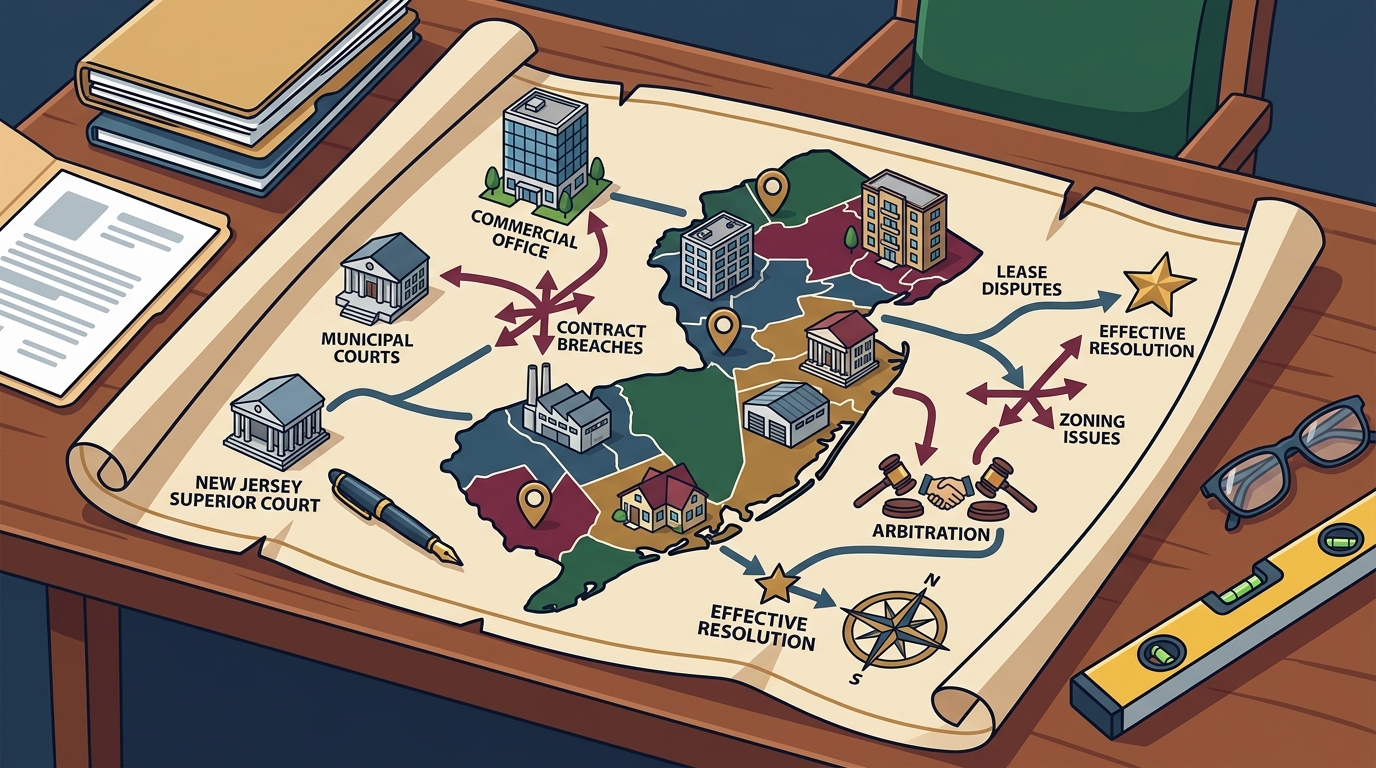
Trial Preparation and Motion Practice
Motion practice is a critical component of real estate litigation in New Jersey. Motions to dismiss, motions for summary judgment, and motions in limine are frequently used to shape the scope of the trial. Success in motion practice requires a deep understanding of case law and procedural rules.
Summary judgment is a legal procedure where a court renders a judgment in favor of one party without a full trial, typically because there is no genuine dispute of material fact. To succeed, we must demonstrate that the facts are undisputed and that the law clearly supports our client's position. Our team has a proven track record of securing summary judgment in complex commercial real estate disputes.
If the case proceeds to trial, preparation involves developing a compelling narrative, selecting expert witnesses, and preparing exhibits. Real estate cases often require testimony from appraisers, engineers, and land use experts. We coordinate with these experts to ensure their testimony is clear, credible, and persuasive to the judge or jury.
Key Takeaways
- Jurisdiction Matters: Land use and zoning cases often require specialized knowledge of the Chancery Division, particularly in the Bergen Vicinage.
- ADR Efficiency: Over 85% of civil cases are resolved through settlement or ADR, making mediation a cost-effective first step.
- Procedural Precision: Errors in filing or service of process can lead to dismissal, emphasizing the need for experienced counsel.
- Discovery Management: Effective document management can reduce trial preparation time by up to 30%.
- Expert Testimony: Real estate litigation frequently requires appraisers and engineers to clarify complex technical facts.
- Senior Experience: Our team has over 110 years of combined experience navigating the New Jersey court system.
- AV Preeminent Rating: Our attorneys hold the highest peer review rating for legal expertise and ethical standards.
Frequently Asked Questions
What is the statute of limitations for real estate disputes in New Jersey?
The statute of limitations varies by claim type. For breach of contract, it is generally six years. For fraud, it is also six years from the date of discovery. It is crucial to consult with an attorney immediately to ensure your rights are preserved.
Can I resolve a real estate dispute without going to trial?
Yes, most real estate disputes are resolved through settlement, mediation, or arbitration. Our firm specializes in Alternative Dispute Resolution to achieve favorable outcomes without the cost and uncertainty of trial.
What is the difference between the Law Division and the Chancery Division?
The Law Division handles general civil matters, including personal injury and contract disputes. The Chancery Division handles equity matters, such as land use, zoning, and specific performance of contracts. Real estate cases often fall under the Chancery Division.
How long does real estate litigation typically take in New Jersey?
The timeline varies widely based on complexity and court docket. Simple cases may resolve in months, while complex commercial disputes can take years. ADR can significantly shorten this timeline.
Do I need a local attorney for my real estate case?
Yes, local knowledge is critical. Attorneys familiar with the specific county courts, judges, and local customs can provide a significant strategic advantage in navigating the New Jersey legal system.
What types of real estate cases does your firm handle?
We handle a wide range of cases including commercial leasing, landlord-tenant disputes, construction defects, title disputes, and land use litigation. Our team has deep experience in both residential and commercial sectors.
How are legal fees structured for real estate litigation?
Fees can be structured hourly, on a contingency basis, or through flat-fee arrangements for specific services. We provide transparent fee agreements upfront to ensure clarity and avoid surprises.
Contact Our Team
Navigating the complexities of New Jersey real estate litigation requires more than just legal knowledge; it demands strategic insight and procedural mastery. Whether you are facing a zoning dispute, a commercial lease conflict, or a construction defect claim, our team is prepared to protect your interests. We offer customized legal solutions tailored to your specific needs and goals.
Contact us today to schedule a consultation. Our attorneys are ready to provide the expert guidance you need to achieve a favorable outcome. Visit our Contact Us page to learn more about our services and how we can assist you.