

How to Navigate the New Jersey Court System for Real Estate Litigation
Real estate disputes in New Jersey can involve everything from breached purchase contracts to boundary disagreements and zoning challenges. Understanding how the state court system handles these cases is essential before you file a single document. The New Jersey Superior Court is the primary venue for real estate litigation, but which division hears your case depends on the type of relief you seek. In this guide, we walk through the court structure, key litigation phases, timeline expectations, and practical strategies so you can approach your dispute with confidence and clarity.
Understanding the NJ Superior Court Structure
The New Jersey Superior Court is the state's general trial court. It has three main divisions: the Law Division, the Chancery Division, and the Appellate Division. Real estate litigation can land in either the Law Division or the Chancery Division depending on what you are asking the court to do.
Law Division vs. Chancery Division
The Law Division handles civil cases where the primary relief sought is monetary damages. The Chancery Division is New Jersey's court of equity, meaning it can grant relief that goes beyond simply awarding money, such as ordering a party to perform a specific act or stop harmful conduct. Most cases involving real estate are filed in the Chancery Division, General Equity Part, because property disputes often require equitable remedies like specific performance, partition, or quiet title actions.
The Role of the Appellate Division
If you disagree with a trial court ruling, you may appeal to the Appellate Division. The Appellate Division reviews judgments from both the Law Division and the Chancery Division but does not re-examine the underlying facts of the case.
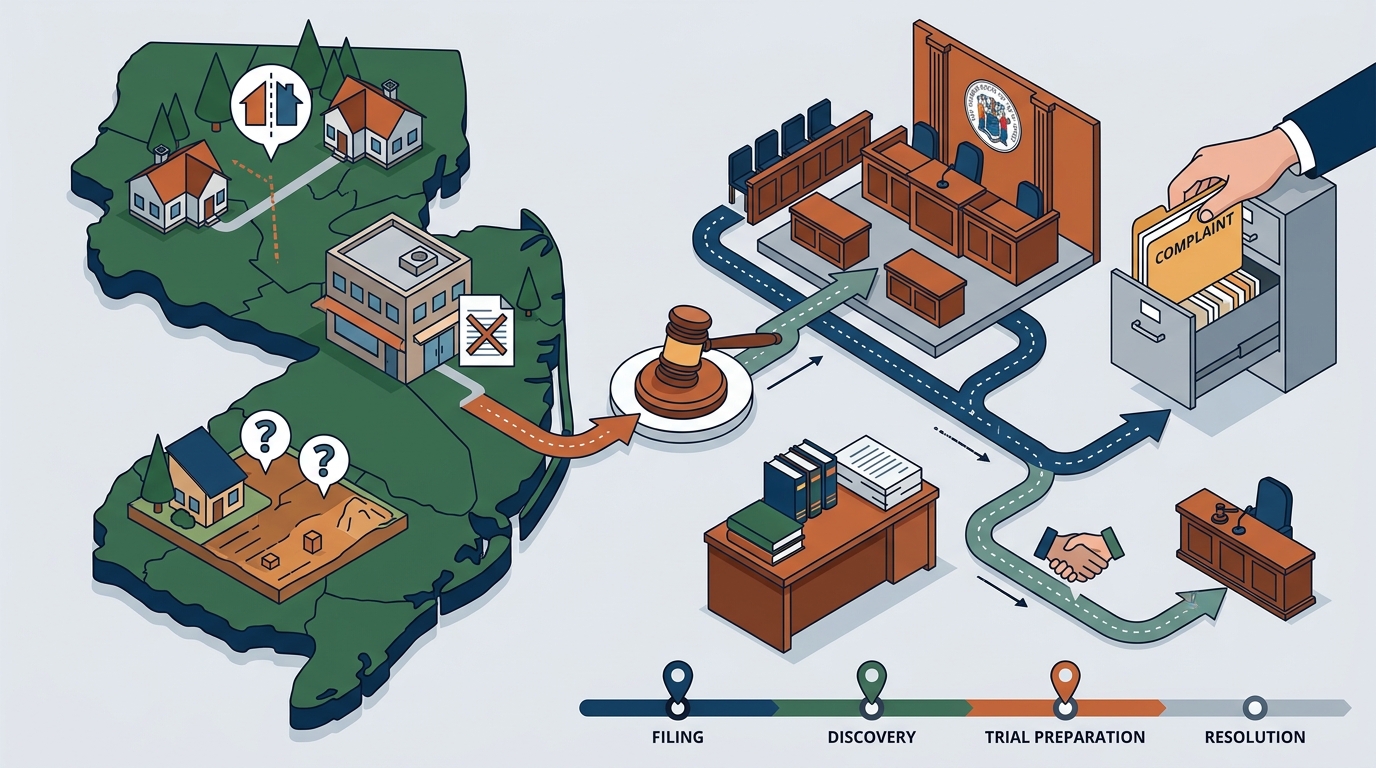
Where to File Your Real Estate Case
Choosing the correct division and venue is one of the first critical decisions in any real estate litigation matter. Here is a simplified breakdown:
| Relief Sought | Court Division | Examples |
|---|---|---|
| Money damages only | Law Division, Civil Part | Breach of purchase agreement, fraud claims |
| Equitable relief (non-monetary) | Chancery Division, General Equity | Specific performance, partition, quiet title, foreclosure |
| Claims up to $20,000 | Special Civil Part | Security deposit disputes, small damage claims |
| Claims up to $5,000 | Small Claims Section | Minor property damage, unpaid rent |
New Jersey is divided into 15 vicinages for administrative purposes. You generally file in the county where the property is located. Working with an experienced litigation attorney ensures your complaint is filed in the proper court from the start.
Common Types of Real Estate Disputes in New Jersey
Real estate litigation is a broad category covering a wide range of conflicts between property owners, buyers, sellers, tenants, and developers. Common dispute types include:
- Contract disputes: Disagreements over sale price, closing conditions, or contract contingencies.
- Boundary disputes: Conflicts over property lines that may require professional surveys.
- Title defects: Issues with liens, encumbrances, or competing ownership claims.
- Landlord-tenant conflicts: Lease violations, unlawful evictions, or habitability issues.
- Zoning and land use challenges: Appeals of planning board decisions or variance denials.
- Construction defects: Claims involving defective work on residential or commercial projects.
Our firm handles many of these areas through our land use, construction law, and landlord-tenant law practice groups.
Step-by-Step Litigation Process
Real estate litigation in New Jersey follows a structured sequence. Understanding each phase helps you prepare and set realistic expectations.
1. Filing the Complaint
The process begins with the filing of a complaint in the appropriate New Jersey court. The complaint must outline the facts of the dispute, the legal claims being made, and the relief sought. A Civil Case Information Statement (CIS) must accompany the complaint to classify the case type and complexity.
2. Discovery
Discovery is the phase where both parties exchange relevant information and documents. This can include interrogatories, requests for production of documents, and depositions. Thorough discovery builds the factual record that often determines the outcome at trial or settlement.
3. Motions and Summary Judgment
Either party may file a motion for summary judgment, asking the court to rule without a full trial. Summary judgment is appropriate when there are no genuine disputes over the key facts and one party is entitled to judgment as a matter of law. Pretrial motions can also resolve procedural and evidentiary issues.
4. Trial
If the case proceeds to trial, each side presents evidence, calls witnesses, and makes legal arguments before a judge (or jury in Law Division cases). In Chancery Division matters, cases are tried by a judge without a jury. In civil actions heard in the Law Division, a jury typically consists of six persons unless the court orders twelve.
Discovery Tracks and Timeline Expectations
New Jersey assigns civil cases to one of four discovery tracks based on complexity. Understanding these tracks helps set realistic timelines for resolution.
| Track | Discovery Period | Typical Case Types |
|---|---|---|
| Track I | 150 days | Simple contract disputes, minor property damage |
| Track II | 300 days | Standard real estate claims, title disputes |
| Track III | 450 days | Complex commercial real estate matters |
| Track IV | 450 days (managed) | Multi-party construction defect cases, CBLP cases |
The Complex Business Litigation Program (CBLP), added by the New Jersey Supreme Court in 2015, falls within Track IV and provides a dedicated judge for complex commercial disputes. An experienced commercial real estate attorney can help you anticipate the right track assignment and manage the timeline strategically.
Alternative Dispute Resolution Options
Alternative dispute resolution (ADR) is a set of processes that allow parties to resolve disputes outside of a traditional courtroom trial. ADR includes mediation and arbitration, both of which can save significant time and legal costs compared to full litigation.
New Jersey courts actively encourage ADR. Many real estate cases are referred to mediation before trial. LoFaro Carver LLC offers dedicated alternative dispute resolution services led by attorneys with bench experience, including the Hon. Alexander H. Carver, III, J.S.C. (Ret.) and the Hon. James J. Guida, J.S.C. (Ret.), who bring firsthand knowledge of how New Jersey courts evaluate real estate matters.
Key Takeaways
- The New Jersey Superior Court is the primary venue for real estate litigation, divided into the Law Division (monetary claims) and Chancery Division (equitable relief).
- Most real estate cases involving property rights, title disputes, or specific performance belong in the Chancery Division, General Equity Part.
- Every case begins with a complaint and a Civil Case Information Statement filed in the correct county.
- Discovery can last from 150 to 450 days depending on your assigned track.
- Summary judgment motions can resolve cases before trial when the facts are undisputed.
- ADR options like mediation and arbitration offer faster, less costly alternatives to a full trial.
- Retaining an attorney experienced in New Jersey's court rules prevents costly procedural mistakes.
Frequently Asked Questions
What court handles real estate lawsuits in New Jersey?
Most real estate lawsuits in New Jersey are filed in the Superior Court. Cases seeking money damages go to the Law Division, while cases requiring equitable relief like specific performance or partition are heard in the Chancery Division, General Equity Part.
How long does real estate litigation take in New Jersey?
Timelines vary based on case complexity. Discovery alone can range from 150 days (Track I) to 450 days (Track IV). Including pretrial motions, settlement negotiations, and potential trial, many cases take one to three years to resolve fully.
What is the Chancery Division in New Jersey?
The Chancery Division is the equity court within the New Jersey Superior Court. It handles cases where a party seeks non-monetary relief, such as an injunction, specific performance of a real estate contract, or partition of jointly owned property.
Can I resolve a real estate dispute without going to trial?
Yes. Alternative dispute resolution methods like mediation and arbitration are widely used in New Jersey. Courts often refer cases to mediation before trial, and many real estate disputes settle during or after the discovery phase.
What documents do I need to file a real estate lawsuit in NJ?
You need a complaint outlining your claims and the relief sought, a Civil Case Information Statement (CIS), and payment of the applicable filing fee. Additional documents like contracts, deeds, and survey reports should be preserved for discovery.
What is specific performance in a real estate case?
Specific performance is an equitable remedy in which a court orders a party to fulfill its obligations under a contract. It is commonly sought in real estate cases because each property is considered unique, and monetary damages alone may not adequately compensate the injured party.
Do I need a lawyer for real estate litigation in New Jersey?
While individuals may represent themselves, corporations and other entities must be represented by a New Jersey licensed attorney under Rule 1:21-1(c). Given the procedural complexity and strict court rules, experienced legal counsel is strongly recommended for all parties.
What is the difference between the Law Division and the Chancery Division?
The Law Division primarily handles cases seeking monetary damages and offers jury trials. The Chancery Division handles cases seeking equitable (non-monetary) relief and cases are decided by a judge without a jury.
Get Experienced Legal Help for Your Real Estate Dispute
Navigating the New Jersey court system requires more than knowing which forms to file. It demands an understanding of court rules, discovery strategy, and how judges evaluate real estate claims. LoFaro Carver LLC has over 110 years of combined experience representing individuals, corporations, and entrepreneurs in real estate law and litigation across New Jersey. Contact our team today to discuss your case and develop a strategy tailored to your goals.