
How to Navigate the New Jersey Court System for Real Estate Litigation
Real estate disputes in New Jersey can involve everything from contract breaches and boundary disagreements to foreclosure defense and zoning challenges. Understanding which court hears your case, how to file, and what to expect at each stage is critical to protecting your property rights. With over 110 years of combined experience in the New Jersey court system, the attorneys at LoFaro Carver LLC guide individuals, corporations, and entrepreneurs through every phase of real estate litigation. This guide walks you through the key steps, court divisions, and strategies you need to know.
Understanding the New Jersey Court Structure
The New Jersey Superior Court is the primary trial-level court in the state. A trial court is the court where cases are first heard, evidence is presented, and a judge or jury renders a decision. The Superior Court is divided into several divisions, each handling different types of cases.
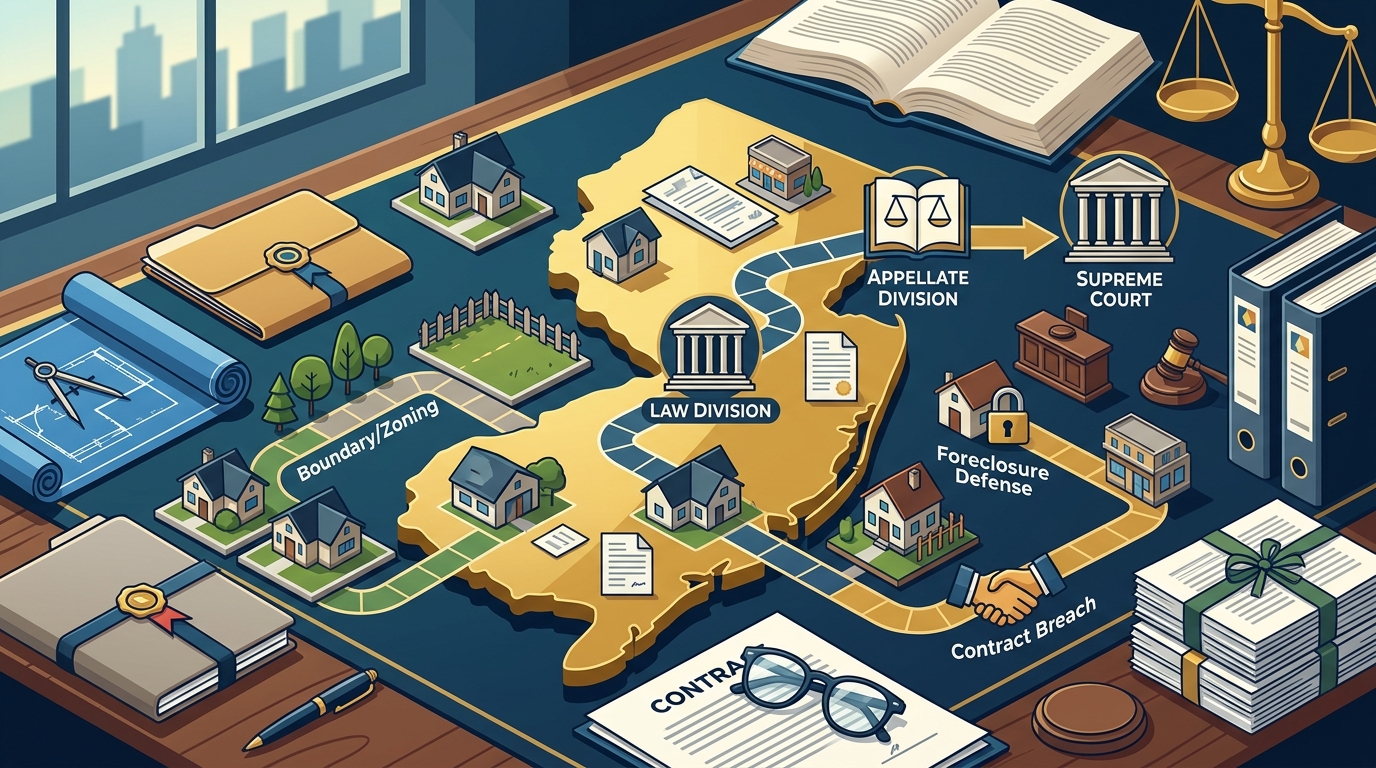
For real estate litigation, two divisions matter most: the Law Division and the Chancery Division. The Law Division handles lawsuits that seek primarily monetary damages, such as compensation for breach of a purchase agreement. The Chancery Division, General Equity Part, handles cases where a party seeks non-monetary relief, like forcing the completion of a sale through specific performance or injunctive orders.
The Role of the Chancery Division in Property Cases
Most real estate cases in New Jersey end up in the Chancery Division. A Chancery action is a lawsuit filed in the equity court where the primary relief sought goes beyond money damages. Foreclosures, quiet title actions, partition suits, and specific performance claims are all heard here. Cases in the General Equity Part are decided by a judge without a jury, which often leads to more efficient resolution of complex property matters.
Where to File Your Real Estate Case
Under New Jersey Court Rule 4:3-2, venue for actions affecting title to real property must be laid in the county where the property is located. This means if you are disputing ownership of a commercial building in Bergen County, your case must be filed in the Bergen County Superior Court.
| Case Type | Court Division | Typical Relief |
|---|---|---|
| Breach of purchase contract (money damages only) | Law Division, Civil Part | Monetary compensation |
| Specific performance of sale | Chancery Division, General Equity | Court-ordered completion of sale |
| Boundary / quiet title dispute | Chancery Division, General Equity | Declaratory judgment on ownership |
| Foreclosure | Chancery Division, General Equity | Sale of property to satisfy debt |
| Land use / zoning appeal | Law Division (Prerogative Writ) | Review of board decision |
| Landlord-tenant (commercial) | Law Division, Special Civil Part | Eviction, damages |
If your claim is $20,000 or less, it may be filed in the Special Civil Part. Claims up to $5,000 can go to Small Claims. For larger or more complex property disputes, the Civil Part or Chancery Division is appropriate. Experienced land use attorneys can help determine the correct filing venue.
The Filing Process Step by Step
1. Prepare and File the Complaint
Real estate litigation begins with the filing of a complaint in the appropriate New Jersey Superior Court. The complaint must outline the facts of the dispute, the legal claims being made, and the relief sought. You must also submit a Civil Case Information Statement (CIS), which classifies the case type and indicates its complexity.
2. Serve the Defendant
After filing, the complaint and summons must be properly served on all defendants. Personal service by a process server or sheriff is standard. If personal service is not possible, the rules permit service by certified mail under certain conditions. Proper service is essential because the court will only have jurisdiction over defendants if valid service of process is made.
3. The Defendant Responds
The defendant typically has 35 days to file an answer and any counterclaims. Failure to respond can result in a default judgment. If you are a defendant in a real estate suit, prompt consultation with a litigation attorney experienced in property matters is critical.
Discovery, Motions, and Pre-Trial Practice
Discovery is the phase where both parties exchange relevant information and documents. This includes interrogatories (written questions), requests for production of documents, and depositions (sworn testimony). In real estate cases, discovery often involves property surveys, title searches, contracts, communications, and expert appraisals.
Summary Judgment
Either party may file a motion for summary judgment, asking the court to rule without a full trial. Summary judgment is appropriate when there are no genuine disputes over key facts and one party is entitled to judgment as a matter of law. This can resolve straightforward breach-of-contract cases or title disputes efficiently.
Pre-Trial Conference
Before trial, the court holds a pre-trial conference to narrow the issues, encourage settlement, and set trial logistics. New Jersey courts actively manage their civil dockets to reduce delays.
Trial, Settlement, and Alternative Dispute Resolution
If the case does not settle, it proceeds to trial. In Chancery Division cases, a judge alone decides the outcome. In Law Division cases, either party may request a jury trial. Both sides present evidence, call witnesses, and make legal arguments.
Many real estate disputes, however, are resolved before trial through negotiation, mediation, or arbitration. Alternative dispute resolution (ADR) is a process by which parties resolve conflicts outside of traditional court proceedings. ADR can save significant time and legal costs, particularly in complex commercial property disputes. LoFaro Carver LLC has dedicated practitioners in mediation and arbitration who help clients reach favorable outcomes without the uncertainty of trial.
Common Real Estate Disputes in New Jersey
Understanding the types of cases that arise helps you prepare a stronger legal strategy:
- Contract disputes: Disagreements over sale price, closing dates, or property conditions.
- Boundary disputes: Conflicts over property lines, often requiring professional surveys.
- Title defects: Issues with ownership history, liens, or encumbrances.
- Zoning and land use challenges: Appeals from planning board or zoning board decisions, handled as prerogative writ actions in Superior Court.
- Foreclosure defense: Protecting homeowner or commercial property rights under New Jersey's Fair Foreclosure Act (N.J.S.A. 2A:50-53).
- Construction defect claims: Disputes with developers or contractors over property conditions.
Key Takeaways
- Most New Jersey real estate litigation is heard in the Superior Court's Chancery Division (General Equity Part) or the Law Division.
- Venue for property cases must be in the county where the real estate is located, per Court Rule 4:3-2.
- The complaint, Civil Case Information Statement, and proper service of process are required to initiate a case.
- Discovery, summary judgment motions, and pre-trial conferences are critical stages before trial.
- Alternative dispute resolution, including mediation and arbitration, can resolve cases faster and at lower cost.
- Real estate litigation is complex and benefits greatly from experienced legal counsel familiar with New Jersey court procedures.
- LoFaro Carver LLC brings over 110 years of combined experience, including a former NJ Superior Court judge, to real estate litigation matters.
Frequently Asked Questions
What court handles real estate disputes in New Jersey?
Most real estate disputes are filed in the New Jersey Superior Court. Cases seeking equitable relief like specific performance or foreclosure go to the Chancery Division, General Equity Part. Cases seeking only money damages are filed in the Law Division, Civil Part.
How long does real estate litigation take in New Jersey?
Timelines vary widely. A straightforward contract dispute may resolve within 6 to 12 months, while complex title or zoning cases can take 18 months or longer. ADR options like mediation can significantly shorten the process.
What is a prerogative writ action?
A prerogative writ action is a lawsuit challenging a decision made by a government body, such as a planning or zoning board. These cases are filed in the Law Division of the Superior Court and are limited to a review of the record from the board hearing below.
Do I need a lawyer for real estate litigation in New Jersey?
While individuals may represent themselves, New Jersey court rules require that corporations and other business entities be represented by an attorney admitted to practice in the state. Given the complexity of property law and procedural requirements, legal representation is strongly recommended for all parties.
What is the difference between the Law Division and Chancery Division?
The Law Division primarily handles cases seeking monetary damages and offers jury trials. The Chancery Division handles cases seeking equitable relief, such as injunctions, specific performance, or foreclosure, and cases are decided by a judge without a jury.
Can real estate disputes be resolved without going to trial?
Yes. Many disputes are resolved through mediation, arbitration, or negotiated settlements. These alternative dispute resolution methods are often faster and less expensive than a full trial.
Where should I file if my property dispute involves land in Bergen County?
Under NJ Court Rule 4:3-2, actions affecting title to real property must be filed in the county where the property is situated. A Bergen County property dispute would be filed in the Bergen County Superior Court.
What does LoFaro Carver LLC offer for real estate litigation?
LoFaro Carver LLC provides comprehensive representation in real estate transactions and litigation, land use proceedings, construction disputes, and alternative dispute resolution. The firm's team includes a former New Jersey Superior Court judge who served as the prerogative writs judge for Bergen County.
Get Experienced Legal Help Today
Navigating New Jersey's court system for a real estate dispute requires knowledge of procedural rules, strategic planning, and experienced advocacy. Whether you are facing a contract dispute, boundary issue, foreclosure, or zoning challenge, the attorneys at LoFaro Carver LLC are ready to help. Contact us today at (201) 498-0400 or visit our Hackensack office at 20 Court Street, Suite 4, to schedule a consultation.