

Corporate disputes are an unavoidable reality of doing business. Whether the conflict involves shareholders, partners, vendors, or rival entities, how you resolve it can determine the future of your company. In New Jersey, business owners have several powerful options ranging from informal negotiation to full-scale litigation. Understanding each method, along with its costs, timelines, and strategic implications, is the first step toward protecting your interests. This guide walks you through every major dispute resolution path available under New Jersey law so you can make an informed decision.
What Are Corporate Disputes?
A corporate dispute is a disagreement between parties involved in a business relationship, such as shareholders, officers, partners, or contracting entities, that may require legal intervention to resolve. These disputes often arise from breaches of fiduciary duty, contract violations, profit-sharing disagreements, or governance conflicts.
In New Jersey, corporate disputes frequently appear in contexts like shareholder and unit owner disputes, construction defect claims, and partnership dissolutions. Choosing the right resolution method early can save significant time and money.
Direct Negotiation: The First Line of Defense
Negotiation is a voluntary, informal process in which the disputing parties (or their attorneys) communicate directly to reach a mutually acceptable outcome. It is the least expensive option and preserves business relationships because there is no adversarial proceeding.
Effective negotiation requires experienced counsel who understands both the legal landscape and the commercial dynamics at play. Attorneys with deep alternative dispute resolution experience can often broker solutions before a matter escalates. When emotions run high in major disputes, however, direct negotiation may stall, making third-party intervention necessary.
Mediation: Guided Settlement With a Neutral Third Party
Mediation is a non-binding process in which a neutral mediator facilitates dialogue between disputing parties to help them reach a voluntary settlement. Unlike a judge or arbitrator, the mediator does not decide the case. Instead, the mediator helps each side understand the other's position and explore creative solutions.
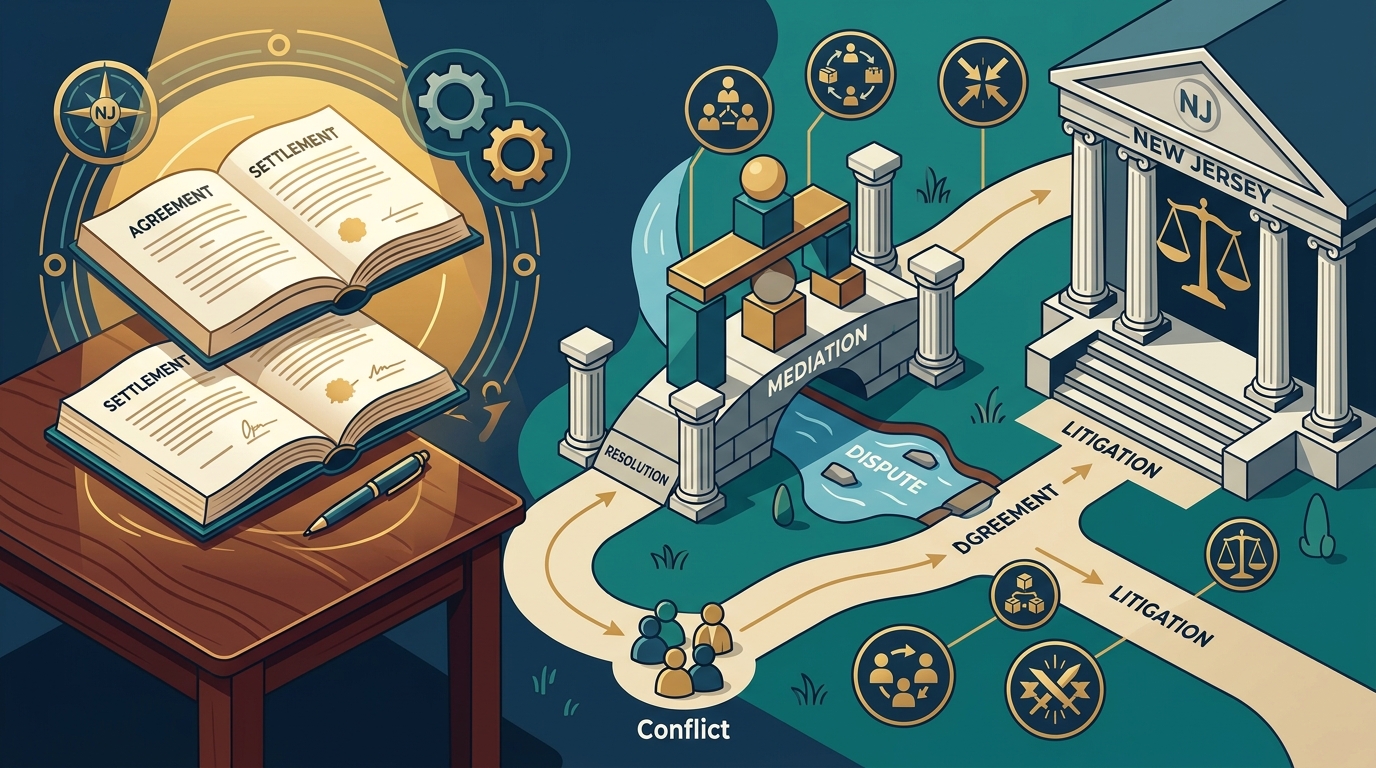
Why Mediation Works in New Jersey
New Jersey courts actively encourage mediation. Under New Jersey Court Rule 1:40, attorneys are required to inform their clients about complementary dispute resolution (CDR) programs. The New Jersey Uniform Mediation Act (N.J.S.A. 2A:23C-1) provides a statutory framework that protects the confidentiality of mediation communications.
When to Choose Mediation
Mediation is most effective when both parties genuinely want to resolve the dispute, when there are ongoing business relationships worth preserving, or when the cost of litigation would be disproportionate to the amount at stake. A full-day commercial mediation session typically costs a fraction of what a trial would require. LoFaro Carver LLC offers customized, in-person, virtual, and hybrid dispute resolution services to fit each client's needs.
Arbitration: A Private, Binding Decision
Arbitration is an adjudicative process in which a neutral arbitrator (or panel) hears evidence and issues a binding decision called an award. It functions as a private alternative to courtroom litigation. The parties substitute a private forum and decision-maker for a court and judge, but they still submit to a third party's binding resolution.
How Arbitration Arises
Arbitration typically arises in one of two ways: through a pre-existing arbitration clause in a contract, or through a post-dispute agreement between the parties. Many shareholder agreements, vendor contracts, and partnership operating agreements include mandatory arbitration provisions.
Advantages and Limitations
Arbitration is generally faster and less formal than litigation. Discovery is limited, there is no jury, and appeals are severely restricted. However, the binding nature means you give up the right to a full trial. Firms like LoFaro Carver LLC, whose attorneys have handled matters in litigation, arbitration, and mediation across construction and commercial contexts, can advise whether arbitration suits your situation.
Litigation in New Jersey Courts
Litigation is the formal process of resolving a dispute through the court system, culminating in a trial before a judge or jury. It is the most structured and often the most expensive path, but it may be necessary when other methods fail or when injunctive relief is needed.
Where Corporate Cases Are Heard
New Jersey's Superior Court handles most corporate disputes across two divisions. The Law Division generally awards monetary judgments, while the Chancery Division addresses equitable relief such as injunctions, specific performance, and corporate governance matters. Complex business litigation may also be heard in federal court when diversity jurisdiction or federal questions apply.
The Role of Experienced Litigators
Navigating New Jersey's court system demands attorneys with substantial trial experience. Hon. Alexander H. Carver, III, J.S.C. (Ret.), Senior Partner at LoFaro Carver LLC, brings over 45 years of experience as a litigator in both federal and state courts of New Jersey and New York. With over 110 years of combined experience across the firm, LoFaro Carver's team is well-positioned to handle disputes at any stage.
Comparing Your Dispute Resolution Options
| Factor | Negotiation | Mediation | Arbitration | Litigation |
|---|---|---|---|---|
| Binding? | Only if agreement reached | No (voluntary settlement) | Yes (binding award) | Yes (court judgment) |
| Cost | Low | Moderate | Moderate to High | High |
| Timeline | Days to weeks | Weeks to months | Months | Months to years |
| Confidentiality | High | High (protected by statute) | Generally private | Public record |
| Control Over Outcome | Full | Full | Limited | None |
| Appeal Rights | N/A | N/A | Very limited | Full appellate review |
| Best For | Low-stakes or relationship-driven disputes | Moderate disputes with cooperative parties | Contract-mandated or mid-complexity disputes | High-stakes, precedent-setting, or emergency matters |
According to the New Jersey Courts, almost 98 percent of all civil cases are resolved without a trial, underscoring how effective non-litigation methods can be.
Key Takeaways
- Corporate disputes in New Jersey can be resolved through negotiation, mediation, arbitration, or litigation.
- Mediation is a non-binding process where a neutral third party facilitates settlement; it is encouraged under NJ Court Rule 1:40.
- Arbitration is a binding, private adjudicative process that is faster and less formal than a trial.
- Nearly 98% of civil cases in New Jersey are resolved without going to trial.
- The Chancery Division of the NJ Superior Court handles equitable corporate matters, while the Law Division handles monetary claims.
- Review your contracts for existing arbitration or mediation clauses before choosing a strategy.
- Working with attorneys experienced in both ADR and litigation gives you the flexibility to pursue the most effective path.
Frequently Asked Questions
What is the difference between mediation and arbitration in New Jersey?
Mediation is a non-binding process where a neutral mediator helps the parties negotiate a voluntary settlement. Arbitration is a binding process where an arbitrator hears evidence and issues a final decision, similar to a private trial. Both are governed by New Jersey statutes and court rules.
Is arbitration mandatory for corporate disputes in New Jersey?
Not by default. Arbitration is typically required only when a contract between the parties contains an arbitration clause. Parties can also voluntarily agree to arbitrate after a dispute arises.
How long does corporate litigation take in New Jersey?
Timelines vary widely. Simple matters may resolve in several months, while complex commercial litigation in the Superior Court can take one to three years or longer, especially if appeals are involved.
Can I switch from litigation to mediation mid-case?
Yes. New Jersey courts frequently refer cases to mediation even after litigation has begun. Many disputes settle through court-ordered or voluntary mediation before ever reaching trial.
What types of corporate disputes are most common in New Jersey?
Common disputes include shareholder and partnership disagreements, breach of contract claims, construction-related disputes, intellectual property conflicts, and corporate governance issues.
Are mediation communications confidential in New Jersey?
Yes. Under the New Jersey Uniform Mediation Act (N.J.S.A. 2A:23C-1), communications made during mediation are generally privileged and cannot be used as evidence in subsequent proceedings.
How do I choose the right dispute resolution method?
Consider the complexity of the dispute, the relationship between the parties, confidentiality needs, cost constraints, and whether your contract mandates a specific process. An experienced attorney can evaluate these factors and recommend the best approach.
Take the Next Step
If your business is facing a corporate dispute in New Jersey, acting early gives you the widest range of options. Whether you need skilled negotiation, mediation, arbitration, or courtroom litigation, the attorneys at LoFaro Carver LLC have the experience to guide you toward the best resolution. Contact LoFaro Carver LLC today to schedule a consultation and protect your business interests.